Blog
Inside pyannoteAI
Dive into the technology, research, and use cases powering next-generation voice-based applications.
Blog
Inside pyannoteAI
Dive into the technology, research, and use cases powering next-generation voice-based applications.
Blog
Inside pyannoteAI
Dive into the technology, research, and use cases powering next-generation voice-based applications.

Highlight

Introducing Precision-3, our new diarization model
Introducing Precision-3, our new diarization model
Introducing Precision-3: 10.4% lower diarization error, new sensitivity parameters, frame-level speaker probabilities, and speed-to-accuracy operating modes.
Read more

Speaker Diarization, Recognition, and Identification: What's the Difference?
Speaker Diarization, Recognition, and Identification: What's the Difference?
Speaker diarization, recognition, identification, verification: clear definitions, key differences, and where each fits in your Voice AI stack.
Read more
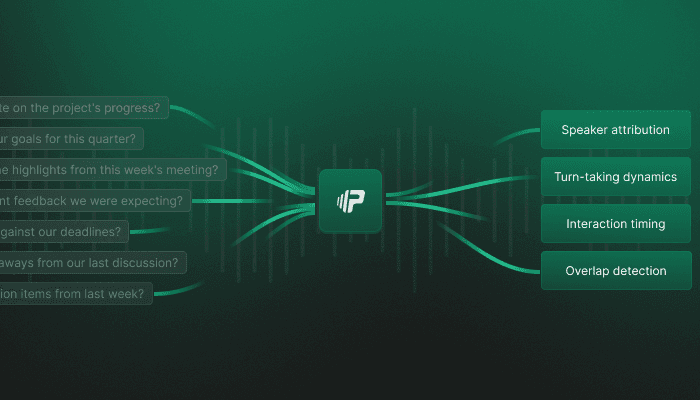
Why conversational context is the real performance driver for your Voice AI stack?
Why conversational context is the real performance driver for your Voice AI stack?
Transcription alone breaks Voice AI pipelines. Learn how conversational context, speaker roles, turn dynamics, and timing drive performance across your entire stack.
Read more
All
Fundamentals
Releases
Tutorials
Engineering & Research
Use Cases
Introducing Precision-3, our new diarization model
Introducing Precision-3: 10.4% lower diarization error, new sensitivity parameters, frame-level speaker probabilities, and speed-to-accuracy operating modes.
Read more

Why speaker intelligence is the missing piece of your Voice AI stack
Transcription accuracy is not what breaks production Voice AI. Speaker diarization, identification, and turn dynamics are the layer most pipelines are missing.
Read more

How Diarization Models Count Speakers (and Why It's Hard)
Why speaker counting is the hardest part of diarization, how clustering-based pipelines estimate it, and how to bypass the failure modes with a single parameter.
Read more

Overlapping Speech and Speaker Separation: The Hardest Problem in Diarization
How do you handle overlapping speakers in transcription? Detect overlap at the diarization layer first, then transcribe separated per-speaker streams.
Read more

Build vs. Buy: The Real Cost of Self-Hosting Diarization
Should you self-host speaker diarization or use an API? A sourced breakdown of GPU cost, engineering tax, accuracy gap, and when each path actually makes sense.
Read more

Why Bundled STT Diarization Fails in Production
Why transcription APIs keep getting speaker labels wrong: the four failure modes that follow from labeling speakers after words, and the fix that doesn't switch vendors.
Read more

Top 7 Speaker Diarization APIs and Models in 2026
What is the best speaker diarization tool in 2026? A sourced comparison of pyannote, AssemblyAI, Deepgram, NeMo, SpeechBrain, Kaldi, and Speechmatics.
Read more

pyannote vs. SpeechBrain for Speaker Diarization
Should you use pyannote or SpeechBrain for speaker diarization? A sourced look at what each project is built for and where the two make different choices.
Read more

pyannote vs. NVIDIA NeMo: Diarization Accuracy, Setup, and Production Readiness
pyannote vs. NVIDIA NeMo Sortformer: how the two open diarization stacks compare on accuracy, speaker limits, setup, and production readiness.
Read more
Introducing Precision-3, our new diarization model
Introducing Precision-3: 10.4% lower diarization error, new sensitivity parameters, frame-level speaker probabilities, and speed-to-accuracy operating modes.
Read more
Why speaker intelligence is the missing piece of your Voice AI stack
Transcription accuracy is not what breaks production Voice AI. Speaker diarization, identification, and turn dynamics are the layer most pipelines are missing.
Read more
How Diarization Models Count Speakers (and Why It's Hard)
Why speaker counting is the hardest part of diarization, how clustering-based pipelines estimate it, and how to bypass the failure modes with a single parameter.
Read more
Overlapping Speech and Speaker Separation: The Hardest Problem in Diarization
How do you handle overlapping speakers in transcription? Detect overlap at the diarization layer first, then transcribe separated per-speaker streams.
Read more
Build vs. Buy: The Real Cost of Self-Hosting Diarization
Should you self-host speaker diarization or use an API? A sourced breakdown of GPU cost, engineering tax, accuracy gap, and when each path actually makes sense.
Read more
Why Bundled STT Diarization Fails in Production
Why transcription APIs keep getting speaker labels wrong: the four failure modes that follow from labeling speakers after words, and the fix that doesn't switch vendors.
Read more
Top 7 Speaker Diarization APIs and Models in 2026
What is the best speaker diarization tool in 2026? A sourced comparison of pyannote, AssemblyAI, Deepgram, NeMo, SpeechBrain, Kaldi, and Speechmatics.
Read more
pyannote vs. SpeechBrain for Speaker Diarization
Should you use pyannote or SpeechBrain for speaker diarization? A sourced look at what each project is built for and where the two make different choices.
Read more
Introducing Precision-3, our new diarization model
Introducing Precision-3: 10.4% lower diarization error, new sensitivity parameters, frame-level speaker probabilities, and speed-to-accuracy operating modes.
Read more
Why speaker intelligence is the missing piece of your Voice AI stack
Transcription accuracy is not what breaks production Voice AI. Speaker diarization, identification, and turn dynamics are the layer most pipelines are missing.
Read more
How Diarization Models Count Speakers (and Why It's Hard)
Why speaker counting is the hardest part of diarization, how clustering-based pipelines estimate it, and how to bypass the failure modes with a single parameter.
Read more
Overlapping Speech and Speaker Separation: The Hardest Problem in Diarization
How do you handle overlapping speakers in transcription? Detect overlap at the diarization layer first, then transcribe separated per-speaker streams.
Read more
Build vs. Buy: The Real Cost of Self-Hosting Diarization
Should you self-host speaker diarization or use an API? A sourced breakdown of GPU cost, engineering tax, accuracy gap, and when each path actually makes sense.
Read more
Why Bundled STT Diarization Fails in Production
Why transcription APIs keep getting speaker labels wrong: the four failure modes that follow from labeling speakers after words, and the fix that doesn't switch vendors.
Read more
Speaker Intelligence Platform for developers
Detect, segment, label and separate speakers in any language.

Make the most of conversational speech
with AI
Detect, segment, label and separate speakers in any language.
Speaker Intelligence Platform for developers
Detect, segment, label and separate speakers in any language.