Blog
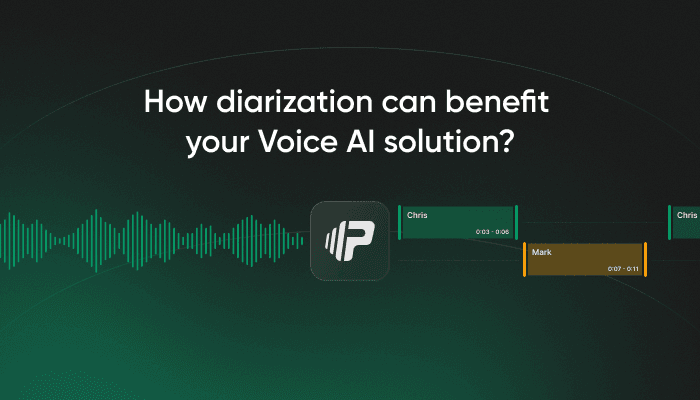
When building a Voice AI solution, accurate transcription is just the beginning. The real challenge lies in understanding who said what and when. Enter speaker diarization.
Speaker diarization is the process of partitioning an audio stream into segments according to speaker identity. It answers the fundamental question: "Who spoke when?" For any Voice AI system processing multi-speaker audio, diarization transforms raw transcripts into structured, actionable intelligence that drives measurable business outcomes.
Without answers to these questions, even a perfect transcription delivers limited value. This is where speaker diarization transforms Voice AI from a transcription tool into an intelligence engine.
From speech-to-text to conversation intelligence
Speech-to-text converts audio into words. That is table stakes.
Real conversations are multi-speaker, dynamic, and messy. Speakers interrupt each other, overlap, pause, switch roles - often all in one conversation. Without diarization, a transcript is just a block of text with timestamps. It is hard to read and harder to analyze.
Speaker diarization structures the conversation: It segments the audio, groups those segments by speaker, and assigns speaker labels consistently across the recording. The output is simple yet powerful: a timeline of who spoke when.
That structure is what makes Voice AI systems shift from transcription to intelligence.
Once speech is attributed to speakers, downstream systems can reason about behavior, roles, intent, and interaction patterns. That is where business value appears.
Core technical capabilities: What production-grade diarization requires
Robust speaker diarization isn't a single algorithm; it's a sophisticated pipeline of components, each addressing specific challenges in multi-speaker audio processing.
Voice Activity Detection (VAD)
Before identifying speakers, the system must distinguish speech from silence, background noise, music, or non-speech audio events. Production-grade VAD operates with millisecond precision, handling real-world conditions like background chatter, keyboard noise, and network artifacts that plague original recordings.
Speaker segmentation and clustering
Once speech regions are identified, the system must segment the audio into speaker turns and group segments belonging to the same speaker. This requires:
Acoustic feature extraction: Converting raw audio into speaker-discriminative representations (embeddings) that capture vocal characteristics while remaining invariant to content, emotion, and channel effects
Temporal modeling: Detecting speaker change points even when transitions are abrupt or unmarked by silence
Clustering algorithms: Grouping segments by speaker identity without knowing in advance how many speakers are present
Overlapping speech detection
Real conversations involve interruptions, backchannels ("mm-hmm"), and simultaneous speech. Systems that simply assign each time frame to a single speaker lose critical information. Advanced diarization handles overlap explicitly, labeling regions where multiple speakers are active simultaneously, essential for accurate turn-taking analysis and complete transcription.
Speaker identification and tracking
Beyond clustering anonymous speakers, production systems often require:
Consistent speaker labels: Maintaining stable speaker identifiers across multiple recordings (e.g., labeling "Agent_001" across all their calls)
Enrollment and verification: Matching detected speakers against known voice profiles
Cross-session tracking: Recognizing the same speaker across different conversations or meetings
From unstructured audio to structured intelligence
The transformative power of diarization lies in converting audio from an opaque binary file into queryable, analyzable data with rich temporal and speaker structure.
Without diarization, a 30-minute meeting yields a linear transcript. With diarization, that same meeting becomes:
A temporal map of who spoke when, for how long, and with what frequency
Speaker-specific transcripts enabling targeted analysis
Turn-taking dynamics revealing conversation balance and participation patterns
Searchable, indexed content at the speaker-utterance level
This structural transformation enables downstream applications that would be impossible with ASR alone:
Semantic search and retrieval: "Find all moments where Speaker_2 discussed pricing" becomes a traceable query.
Automated summarization: Generate per-speaker summaries or extract speaker-specific action items rather than generic meeting notes.
Analytics and metrics: Compute talk-time ratios, interruption frequencies, response latencies, and engagement patterns, and quantitative insights into conversation dynamics.
Compliance and quality monitoring: Automatically flag calls where agents failed to provide required disclosures or deviated from scripts, with precise timestamps.
Concrete use cases: What's unlocked with diarization? OR What does diarization unlock?
Call Center intelligence
Contact centers generate millions of customer-agent interactions. Diarization enables:
Automated QA scoring: Evaluate agent adherence to scripts, measure customer sentiment shifts, detect compliance violations, all requiring attribution to specific speakers
Coaching insights: Identify top performers by analyzing their talk patterns, question techniques, and handling of objections
Customer journey analysis: Track how specific customers behave across multiple calls by linking speaker profiles to CRM records
Without diarization, you can transcribe calls but cannot separate agent behavior from customer behavior, rendering most analytics meaningless.
Meeting transcription and productivity
Enterprise meeting solutions depend on diarization to deliver:
Attributed transcripts: Participants need to know who said what, both for clarity and accountability
Action item extraction: Assign tasks to specific individuals based on their commitments during the meeting
Participation analytics: Provide meeting organizers with insights about speaking time distribution and engagement
Generic transcription of meetings without speaker labels produces documents that participants must manually edit to add attribution, eliminating the automation benefit.
Voice assistants and conversational AI
Multi-user environments (homes, vehicles, shared spaces) require assistants to:
Recognize individual users: Personalize responses, access user-specific preferences and data, maintain separate conversation histories
Manage multi-party interactions: Track which family member issued a request, handle interruptions, and arbitrate conflicting requests
Provide speaker-aware responses: "Remind me to..." must identify who "me" refers to in a multi-user context
Media processing and content indexing
Broadcasters, podcasters, and content platforms use diarization to:
Generate searchable transcripts: Enable viewers to jump to moments when specific guests speak
Create speaker-specific clips: Automatically extract segments featuring particular individuals for social media or promotional use
Facilitate post-production: Accelerate editing by providing precise speaker boundaries for inserting graphics, captions, or B-roll
Research and clinical documentation
In medical, legal, and research contexts, diarization enables:
Clinical note generation: Separate physician questions from patient responses in telemedicine consultations
Legal deposition analysis: Attribute statements to specific participants in multi-party proceedings
Behavioral research: Analyze conversational dynamics, turn-taking patterns, and interaction styles in naturalistic settings
Automatic dubbing and localization
International content distribution increasingly relies on diarization to:
Map voices to speakers: Ensure consistent voice actors dub the same characters across episodes
Preserve speaker characteristics: Match dubbed voice attributes (gender, age, tone) to original speakers
Synchronize multi-speaker scenes: Maintain accurate timing and overlap patterns in dubbed versions
Speaker-centric applications: Beyond basic attribution
Advanced Voice AI solutions leverage diarization to enable entirely new application categories:
Voice biometrics and authentication: Diarization systems that build speaker models enable passive authentication, identifying users by their voice patterns rather than requiring explicit credentials.
Personalized user experiences: Assistants that recognize family members can customize responses, access permissions, content recommendations, and conversation context per individual.
Speaker-level sentiment and emotion analysis: Rather than assessing overall call sentiment, analyze each speaker's emotional trajectory independently, which is critical for understanding the evolution of customer satisfaction during support calls.
Conversation-style coaching: Provide professionals (salespeople, therapists, teachers) with feedback on their conversational patterns (interruption frequency, question-to-statement ratios, pacing, and response timing).
Real-world challenges: Why robust diarization matters
Production environments present challenges that stress-test diarization systems:
Acoustic variability: Background noise, poor microphone quality, network packet loss, music, and non-speech sounds must be handled gracefully without degrading speaker separation.
Overlapping speech: Real conversations involve frequent overlap; studies show overlap in 10-30% of conversational time. Systems that ignore overlap sacrifice accuracy and completeness.
Unknown speaker counts: Most real-world scenarios don't specify the number of speakers in advance. Diarization systems must resolve this automatically, handling cases ranging from monologues to large group discussions.
Speaker similarity: When multiple speakers share similar vocal characteristics (same gender, age, or accent), discriminative modeling becomes more challenging, requiring robust embedding spaces and clustering algorithms.
Domain adaptation: A model trained on broadcast news may fail catastrophically on customer service calls, medical consultations, or courtroom proceedings due to domain mismatch. Production diarization requires adaptation to target domains.
These challenges explain why research-grade diarization differs fundamentally from production-grade diarization. Achieving 5-10% Diarization Error Rate (DER) in controlled settings is valuable; maintaining such performance on noisy, overlapping, real-world audio at scale is what separates experimental systems from deployable solutions.
Conclusion: Diarization as essential infrastructure
Speaker diarization is not an optional enhancement for Voice AI solutions; it's a foundational infrastructure that determines whether your system can deliver actual intelligence or merely convert sound waves into text.
Every meaningful Voice AI application beyond simple dictation depends on knowing who spoke when:
Contact centers cannot analyze agent performance without attributing utterances to agents
Meeting assistants cannot assign action items without knowing who made commitments
Voice authentication requires speaker recognition
Content indexing needs speaker-specific search
Compliance monitoring demands attribution to verify required disclosures
As Voice AI solutions move from simple transcription to intelligent analysis, automation, and decision support, diarization capabilities become the differentiator between systems that scale in production and those that remain proof-of-concept demos.
The question is not whether your Voice AI solution needs diarization, but whether your diarization is robust enough to handle the acoustic variability, speaker overlap, and context diversity of real-world audio. The answer to that question determines whether your Voice AI delivers on its promise or becomes another transcription tool that users must manually post-process.
