Blog
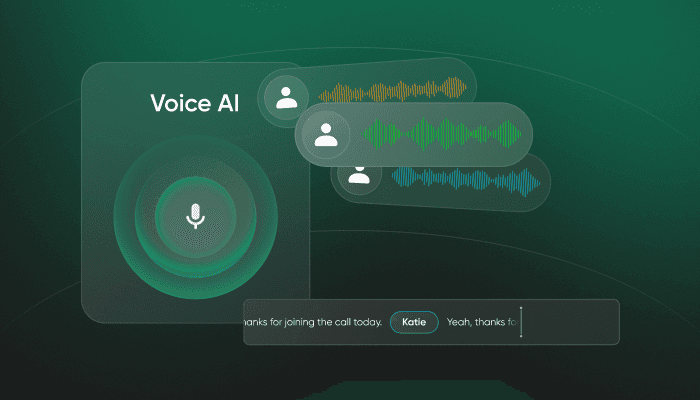
Voice AI systems have matured rapidly. Speech-to-text (STT) accuracy has improved to near-human levels in controlled conditions. Large language models can reason over transcripts with impressive fluency. Yet in production, voice-based platforms continue to struggle with the same class of problems: misattributed speaker turns, intent models that fire on the wrong participant, dialogue managers that lose track of context after an interruption. The cause is rarely the models themselves. It is what they are given to work with.
Most Voice AI pipelines hand downstream models a transcript, a flat sequence of words stripped of everything that gave those words meaning in context. Who said this? When, relative to what came before? Did a second speaker overlap? Was there a pause that signaled hesitation or handoff? None of that survives the text reduction. Conversation metadata is the structured layer that preserves it.
What conversation metadata is, and what it’s not?
Conversation metadata is the structured representation of how a conversation unfolds, not what is said. It is derived directly from audio, before meaning is reduced to words, and it describes the interaction itself: its participants, its timing, its dynamics.
This distinction matters. Conversation metadata is not:
A transcript log. Logs record what was said. Metadata describes how the exchange was structured.
An annotation layer. Annotations are typically added post-hoc, by humans or downstream models, based on text. Metadata is produced from raw audio, upstream of any language processing.
Text-derived features. Sentiment scores, topic labels, and intent tags are all derived from content. Conversation metadata is audio-native; it encodes signals that exist in the acoustic signal before any word is decoded.
At pyannoteAI, we define conversation metadata as the set of structured, reusable signals that transform raw audio into a representation of conversational structure. These signals are the foundation on which reliable Voice AI systems are built.
The building blocks: Three dimensions of conversational structure
Conversation metadata can be organized across three dimensions: who speaks, when they speak, and how they speak. Each dimension yields actionable primitives for downstream systems.
Who speaks
Speaker diarization answers the question "who said what" by segmenting audio into speaker-homogeneous regions and assigning consistent identity labels across the full recording. This is not a cosmetic feature. Without stable speaker attribution, every downstream component, STT, intent detection, and dialogue management, operates on ambiguous input.
Beyond the binary distinction of speech versus silence, voice activity detection (VAD) provides fine-grained segmentation that captures hesitations, breath patterns, and non-speech vocalizations. Speaker consistency tracking ensures that a speaker labeled at minute 2 maps to the same entity at minute 47, even across variable acoustic conditions.
When they speak
Turn-taking structure: who speaks when, for how long, and in what sequence, is among the most information-dense features of a conversation. Interruptions indicate urgency or dominance. Overlapping speech is a signal of engagement or conflict. Response latency reveals cognitive load or uncertainty. Silence duration between turns encodes social meaning that transcripts cannot capture.
Timing metadata provides a temporal backbone for conversation. It allows downstream models to reason about sequence, not just content, to know that an utterance was a response, an interruption, or an unprompted initiation.
How they speak
The third dimension captures speaker dynamics: vocal intensity, pacing changes, patterns of dominance and engagement across participants. Sustained silence from one speaker following a question from another carries information. A rising pattern of speech rate and amplitude can be an escalation indicator. These signals are not derivable from text; they must be extracted from the acoustic signal directly.
Together, these three dimensions produce a complete picture of conversational structure: one that is stable, reusable, and independent of the content being discussed.
How conversation metadata improves system behavior
The value of conversation metadata is not abstract. It maps directly to measurable improvements in system behavior across the Voice AI stack.
Speaker attribution becomes stable across time:
When a diarization layer assigns consistent speaker labels before transcription begins, STT systems can apply speaker-specific acoustic models and language model priors. The result is reduced word error rate, particularly in multi-speaker conditions where speaker confusion is a primary source of transcription errors.
STT benefits from speaker-aware decoding:
Single-channel recordings of multi-participant conversations are among the hardest inputs for speech-to-text systems. When the audio stream is pre-segmented by speaker, the decoding problem becomes significantly more tractable. Speaker identity also enables the use of speaker-conditioned models that adapt to individual vocal characteristics.
Intent recognition becomes more reliable due to turn awareness:
Intent models trained on monologue data systematically underperform on conversational input because they lack awareness of turn structure. Knowing that an utterance is a first-turn initiation, a response to a prior turn, or a mid-turn interruption changes the prior probability of intent categories. Conversation metadata provides this context as a stable signal, not an inferred one.
Dialogue systems reduce correction loops:
Dialogue managers that receive speaker-attributed, turn-structured input can maintain state across speaker changes and interruptions. Without this structure, systems resort to positional heuristics, treating the most recent utterance as the active context regardless of speaker, which produces the repetition and correction loops that degrade user experience and inflate handling time.
Conversation flow stabilizes because context persists:
Perhaps most importantly, conversation metadata allows systems to reason about conversation as a coherent object across time, not as a sequence of isolated utterances. A silence of 4 seconds is not the same event in all contexts. An overlap between participants is not equivalent to background noise. Metadata encodes these distinctions and makes them available to every downstream component.
Performance in real-world environments
Controlled benchmark conditions systematically understate the challenge that Voice AI systems face in production. Real audio is noisy. Participants speak over each other. Microphone quality varies by device, environment, and network codec. Domain vocabulary shifts between calls. Speaker characteristics change within a session due to fatigue, stress, or room acoustics.
In these conditions, the text layer alone cannot resolve ambiguity. A transcript that reads "I want to cancel" looks identical whether the speaker is a customer expressing intent or an agent paraphrasing back for confirmation. Without speaker attribution and turn structure, downstream models must guess. They guess wrong at a rate that compounds across pipeline stages.
Conversation metadata addresses this by introducing audio-native signals that are not subject to the same ambiguity. Speaker diarization operates on acoustic features, not linguistic ones. Turn boundaries are detected from silence and energy patterns, not punctuation. These signals are orthogonal to content, which means they remain informative precisely when content-based signals fail.
This has direct consequences for deployment at scale. A Voice AI system built on transcripts alone requires constant retraining as domain conditions shift, because the features it relies on are content-dependent. A system built on conversation metadata has access to structural signals that generalize across domains, because the way humans organize conversations does not change as fast as the topics they discuss.
Several use cases are simply inaccessible to transcription-only systems. Real-time agent assist, where the system must identify which participant is speaking before a full utterance is decoded. Compliance monitoring across multi-party calls, where speaker attribution is a regulatory requirement. Automated quality assurance that measures interruption rates, silence patterns, and talk-time ratios; metrics that are invisible to text-based analysis. Each of these depends on the metadata layer being present, stable, and consistent.
Conversation metadata as a foundation layer
pyannoteAI sits upstream in the Voice AI stack. Before a word is decoded, before an intent is classified, before a dialogue state is updated, the audio must be converted into a structured representation of the conversation it contains. That is what conversation metadata provides, and what pyannoteAI produces.
The output is not a feature set tied to a specific downstream model. It is a set of reusable, system-level primitives: speaker segments, turn boundaries, overlap events, timing signals, and voice activity labels. These primitives are stable across pipeline configurations. They are produced once from audio and consumed by every downstream component that needs them.
This architecture matters for teams building at scale. Rather than inferring conversational structure independently in each pipeline stage and doing so inconsistently, teams can rely on a single, authoritative metadata layer that all components draw from. Speaker attribution is resolved once. Turn structure is defined once. Timing is anchored once. Downstream models receive consistent input regardless of how the rest of the stack evolves.
The alternative: building Voice AI systems that treat each utterance in isolation, derive context from text alone, and handle multi-speaker conditions as an edge case, produces systems that are brittle by construction. They fail not because of model quality but because of what the models are given to reason over.
Conversation metadata changes what Voice AI systems are given. That is why it changes how they work.
pyannote.ai provides speaker diarization and conversation metadata APIs for teams building voice-based platforms and Voice AI solutions. Learn more at pyannote.ai.
