Blog
The voice AI industry has reached an inflection point. Transcription models have never been more accurate, yet production systems still struggle with real-world conversations: customer support platforms misattribute speakers, medical transcription tools confuse patient and provider statements, and meeting intelligence software fails to track who said what when multiple people talk at once.
The problem isn't transcription quality, it's the absence of conversational context.
Most voice AI pipelines treat audio as a sequence of words to be transcribed, ignoring the fundamental structure of human conversation: who is speaking, when they speak, how they interact, and what roles they occupy. This oversight creates a cascading failure across the entire stack. Diarization errors propagate into incorrect speaker labels. Speech-to-text models struggle without speaker-specific adaptation. Downstream NLP tasks like sentiment analysis and intent detection operate on broken inputs, producing unreliable outputs.
The hard truth: running your entire workflow STT → LLMs → TTS is pointless if your speaker-assigned transcription is broken. Without an accurate conversational context, your entire audio chain is broken.
Conversational context is not a nice-to-have feature. It is a performance multiplier that determines whether your voice AI system delivers actionable intelligence or produces expensive garbage.
What is conversational context, and why does it matter?
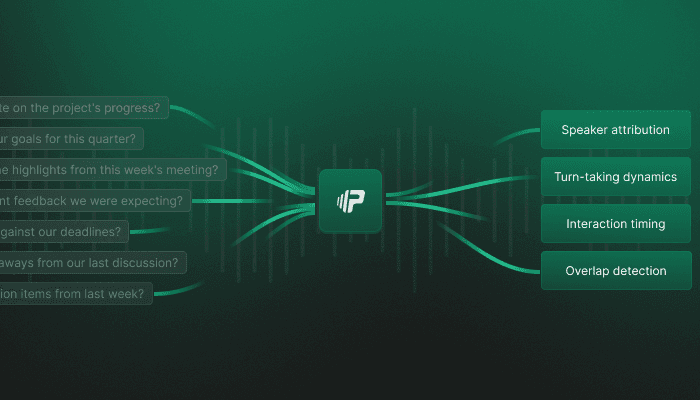
Conversational context encompasses the structural and behavioral metadata that defines how a conversation unfolds. Its intent:
Speaker diarization: Who is speaking at each moment
Speaker identity and roles: Doctor vs. patient, agent vs. customer, manager vs. team member
Turn-taking dynamics: When speakers transition, who interrupts whom, and response latencies
Interaction patterns: Overlapping speech, interruptions, backchannels, pauses
Speaker traits: Speaking rate, pitch patterns, confidence indicators
Ambient audio context: Background noise, acoustic environment, channel conditions
These signals are not cosmetic. They are foundational to understanding what a conversation means. A statement from a doctor carries a different weight than the same words from a patient. An interruption signals urgency or disagreement. A long pause may indicate confusion, consideration, or technical difficulty. Without this context, voice AI systems process speech as disconnected fragments rather than coherent dialogue.
Consider a customer service call where a support agent and customer speak over each other. A context-free transcription might assign the customer's frustration to the agent, or vice versa. Consequently, the resulting sentiment analysis would be inverted, any compliance check would fail, and summarization would misrepresent the interaction. One attribution error, and the reliability of every downstream decision is questioned.
Conversational context prevents this collapse. It anchors speech to speakers, time, and interaction dynamics; transforming raw audio into structured, speaker-aware data that AI systems can reason about reliably.
How conversational context improves every stage of the Voice AI pipeline?
1. Diarization: From speaker segmentation to conversational intelligence
Traditional diarization answers a narrow question: "Who is speaking when?" But in noisy, multi-speaker environments, like call centers, medical consultations, and courtrooms, this question becomes exponentially harder. Speakers overlap, interrupt, whisper, and talk over background noise. Basic diarization models fragment speakers, confuse identities, and drift over time.
Context-aware diarization solves this by exploiting conversational structure.
When a system knows that Speaker A typically responds within 200ms and Speaker B within 800ms, it can use response latency to disambiguate overlapping segments. When it recognizes turn-taking patterns, such as a doctor asking questions and a patient answering, it reduces speaker confusion even when voices are acoustically similar. When it tracks speaker roles across an entire conversation, it anchors identities consistently, preventing the drift that occurs when models treat each utterance independently.
Conversational context also helps manage non-vocal artifacts, ambient noise, cross-talk, and environmental sounds that confuse standard diarization systems. By understanding the interaction context (e.g., a hospital setting where intercom announcements are common), the system can filter out irrelevant audio and focus on the primary conversational participants.
The result: fewer speaker errors, less fragmentation, and more reliable identity tracking. This isn't incremental improvement; it's the difference between a system that works in production and one that doesn't.
2. STT Accuracy: Speaker-adaptive decoding and overlap resolution
Automatic speech recognition has improved dramatically, but STT models still struggle in multi-speaker scenarios. Why? Because they lack conversational context.
Knowing who is speaking enables speaker-adaptive decoding. Different speakers have different accents, speaking rates, vocabularies, and acoustic signatures. A generic STT model applies the same decoding strategy to everyone, leading to systematic errors for speakers whose characteristics diverge from the training distribution. Speaker-aware systems can apply per-speaker adaptation, improving accuracy for each voice.
Knowing when speakers transition reduces attribution errors. In fast-paced conversations, words can be misattributed to the wrong speaker if the system doesn't identify turn boundaries. Context-aware systems use interaction timing to assign words correctly, when one speaker stops and another begins, even during rapid exchanges.
Knowing interaction patterns improves overlap and interruption handling. When two speakers talk simultaneously, standard STT models often fail or produce garbled output. Context-aware systems can predict overlaps based on conversational dynamics (e.g., interruptions are more likely during disagreements), allocate processing resources accordingly, and disentangle overlapping speech more effectively.
The cumulative effect: fewer transcription errors, better speaker attribution, and higher confidence scores. These gains matter especially in high-stakes applications like legal proceedings, medical documentation, and compliance monitoring, where a single transcription error can have serious consequences.
3. Speaker attribution: Resolving ambiguity across time
Speaker attribution is where many voice AI systems fail silently. Even if diarization and STT perform well independently, linking speakers consistently across a long conversation, especially one with interruptions, breaks, or changing participants, remains challenging.
Conversational context provides the anchors needed to maintain speaker identity.
Role-based context helps: if the system knows Speaker 1 is the customer service agent and Speaker 2 is the customer, it can enforce consistency even when acoustic conditions change (e.g., the customer moves to a different room mid-call). Interaction history helps: if Speaker A has been asking questions for ten minutes, a sudden reversal where they start answering questions might indicate a speaker switch or a diarization error that context can flag and correct.
Temporal context matters too. Human conversations exhibit predictable rhythms. Speakers rarely swap roles instantly without transitional cues: questions, acknowledgments, and topic shifts. By modeling these dynamics, context-aware systems detect anomalies that indicate attribution errors and correct them before they propagate downstream.
The outcome: stable, reliable speaker identities across entire conversations. This stability is essential for applications like multi-session therapy transcription, long-form meeting intelligence, and investigative interview analysis, where speaker consistency across hours of audio is non-negotiable.
4. Downstream NLP: Context turns text into reliable signals
Once audio is transcribed and attributed, most voice AI pipelines pass the output to NLP models for sentiment analysis, intent detection, topic extraction, compliance checking, or summarization. This is where context-free systems collapse entirely.
Without speaker-aware inputs, NLP models make catastrophic errors.
Sentiment analysis: "I'm so frustrated" means something very different when spoken by a customer versus a support agent acknowledging the customer's frustration. Context-free sentiment models can't distinguish these cases.
Intent detection: "Can you help me with that?" has a different intent depending on who asks. A doctor asking a nurse has different implications than a patient asking a doctor.
Compliance checks: Regulatory requirements often specify who must say certain things (e.g., agents must disclose terms, doctors must obtain consent). Without speaker attribution, compliance checks produce false positives and false negatives.
Summarization: Effective summaries require understanding who said what, who disagreed, who asked questions, and who made decisions. Without conversational context, summarization models produce incoherent or misleading outputs.
Turn-aware context matters too. Understanding when speakers transition, how quickly they respond, and whether they interrupt each other provides critical signals for intent and sentiment. A delayed response might indicate hesitation or confusion. An interruption might signal urgency or disagreement. A backchannel ("mm-hmm," "yeah") indicates active listening. These interaction dynamics are invisible to context-free NLP models.
By enriching transcripts with conversational context, speaker labels, roles, turn boundaries, and interaction timing, voice AI systems give NLP models the structured inputs they need to perform reliably.
The difference is not marginal. It is the difference between a system that works and one that fails in production.
The strategic implication: Diarization is the entry point, not the end goal
Many organizations treat speaker diarization as a standalone problem: "We need to know who is speaking." This framing underestimates what's at stake.
Diarization is not the end goal. It is the entry point to conversational context.
A robust diarization system doesn't just segment speakers; it unlocks the structured conversational metadata that drives performance across the entire voice AI stack. It enables speaker-adaptive STT. It stabilizes speaker attribution. It provides the inputs downstream NLP models need to produce reliable outputs.
This is why pyannoteAI is best understood not as a diarization model, but as a conversation intelligence platform. It delivers the full spectrum of conversational context: speaker identity, roles, turn-taking, prosody, non-verbal cues, interaction dynamics, and speaker traits that modern voice AI systems require to operate in noisy, multi-speaker, real-world environments.
The future of voice AI performance is not better transcription models alone. Transcription quality is approaching diminishing returns. The next frontier is conversation understanding. Systems that model how people talk, interact, interrupt, respond, and structure dialogue will outperform systems that treat speech as flat text by orders of magnitude.
Context is a performance multiplier, not an add-on
The voice AI stack is only as strong as its understanding of the conversation. Transcription is necessary but insufficient. Without conversational context, diarization errors propagate, STT accuracy degrades, speaker attribution becomes unreliable, and downstream NLP decisions lose precision.
Conversational context (speaker identity, roles, turn-taking, interaction dynamics) transforms raw audio into actionable intelligence. It reduces errors at every pipeline stage. It enables speaker-adaptive processing. It anchors speech to consistent identities and roles. It provides the structured inputs that make downstream AI decisions reliable.
If your speaker-assigned transcription is broken, your entire audio chain is broken. The most sophisticated LLMs, the most advanced TTS systems, and the most carefully tuned NLP models all fail when operating on context-free inputs.
Organizations building production voice AI systems must recognize that conversational context is not an optional enhancement. It is a foundational requirement. Systems that exploit conversational structure will deliver better diarization, better transcription, better attribution, and better downstream performance than systems that ignore it.
