Blog
There is a common assumption embedded in the way most Voice AI systems are initially designed: that a capable speech-to-text model and a powerful language model, wired together, are sufficient for production-grade performance.
This assumption is wrong, and the gap between prototype and production is where that wrongness becomes expensive.
Transcription accuracy is not a fixed property of a model. It is a function of domain vocabulary, acoustic environment, speaker behavior, and conversational structure. Similarly, LLM outputs are only as reliable as the inputs they receive. When those inputs are flat, speaker-agnostic text dumps, language models compensate through heuristics, and that compensation introduces exactly the kind of unpredictability that production systems cannot tolerate.
The solution is not a better STT model or a larger LLM. It is an architectural one: structured conversational metadata must be generated upstream and used to condition every downstream component in the pipeline.
Why transcription performance is never universal
Speech-to-text models are trained to maximize accuracy across broad, heterogeneous datasets. This optimization for generality is also their core limitation in production.
Consider the difference between a general consumer voice assistant and a cardiology consultation transcription system. The latter deals with a narrow, highly specialized vocabulary: drug names with similar phonetics, procedural terminology, dosing instructions spoken quickly under time pressure, and clinical shorthand that does not appear in any standard training corpus. A generic STT model will fail on these terms systematically; not occasionally, but at a rate that corrupts downstream clinical records, triggers compliance failures, and erodes trust in the system.
The same failure modes appear across every domain where Voice AI is deployed at scale. In contact centers, agents use product codes, internal acronyms, and regional expressions that vary by deployment geography. In legal depositions, the distinction between similar-sounding names and case references is legally material. In financial services, regulatory terminology must be transcribed with precision, or the compliance value of the recording evaporates entirely.
Beyond vocabulary, the acoustic environment and interaction format compound the problem. Telephone audio compressed through VoIP codecs behaves differently from headset audio in a quiet office. Multi-speaker meetings with overlapping speech present a fundamentally different decoding challenge than a structured interview. Speaker accents, speech rate, and background noise all shift the probability distributions that STT models rely on. A model calibrated for clean studio speech will degrade in the field, and it will do so unevenly, failing most severely on exactly the high-stakes content you most need to capture correctly.
Reliable production transcription requires domain-adapted models. And domain adaptation requires structured information about the conversational context: who is speaking, in what role, in what acoustic environment, in what type of interaction. That information does not come from the audio waveform alone.
Why LLM reasoning degrades without conversational structure
The assumption that LLMs can reason effectively over raw transcripts similarly underestimates the problem.
Language models are sensitive to input structure. When a transcript arrives as an undifferentiated block of text, no speaker attribution, no turn segmentation, no indication of who asked what, who responded, who interrupted, the model must infer all of that structure from linguistic patterns alone. This inference is often wrong, and the errors propagate silently into summaries, decisions, and compliance outputs.
Take call center quality assurance as a concrete case. An LLM asked to assess whether an agent followed a compliance script cannot do so reliably if it cannot distinguish agent speech from customer speech. The same sequence of words carries entirely different compliance implications depending on who said them. Without speaker-role metadata, the model may produce a plausible-sounding assessment that is factually wrong; attributing agent statements to the customer, missing a required disclosure because it was obscured by a speaker attribution error, or flagging a policy violation that did not occur.
The same structural dependency applies to intent detection, meeting summarization, decision support, and virtually every downstream LLM task in a Voice AI pipeline. Turn segmentation determines whether the model understands that a question was asked and an answer was given, or interprets a multi-turn exchange as a single monologue. Overlap and interruption markers signal tension, urgency, or confusion that affect the meaning of what was said. Silence durations reveal hesitation, processing time, or the end of a conversational phase. None of this is recoverable from flat text.
Without metadata, LLMs do not fail loudly. They fail quietly, producing outputs that look correct but aren't, which is far more dangerous than obvious errors that can be caught and corrected.
Metadata as the conditioning layer
What makes conversational metadata so structurally important is that it functions as a conditioning signal for every component in the Voice AI pipeline, not just LLMs, but also the STT models that feed them.
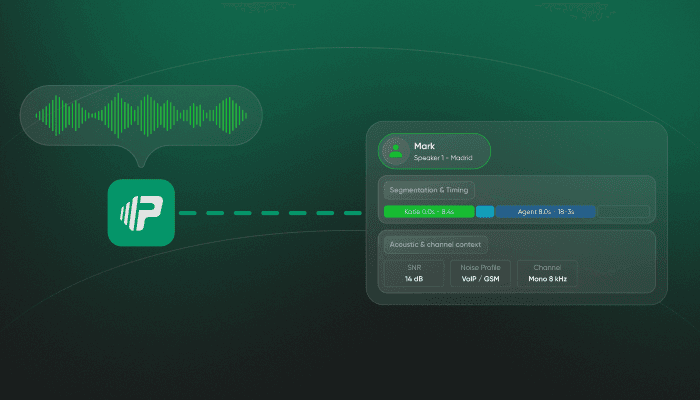
The key metadata signals that speech processing must generate include:
Speaker identity and role signals: Who is speaking at each moment, and in what functional capacity (agent, customer, physician, patient, interviewer, candidate). Role-aware decoding allows STT models to apply domain-specific language models selectively, improving accuracy where it matters most.
Turn segmentation and timing: When each speaker's turn begins and ends, including precise timestamps. Turn boundaries are prerequisites for attribution-accurate LLM inputs and for managing the interaction loop in real-time Voice AI agents.
Overlaps and interruptions: Moments where multiple speakers are active simultaneously. These are acoustically challenging for STT and semantically significant for downstream reasoning. Flagging them explicitly allows both the transcription layer and the LLM to handle them correctly rather than collapsing them into ambiguous output.
Interaction phases: The structural arc of a conversation: opening, problem identification, resolution, closing. Phase-aware inputs enable LLMs to calibrate their reasoning to the conversational moment, improving summarization relevance and decision support accuracy.
Acoustic and channel context: Codec type, channel configuration, background noise level, recording quality. This context informs STT model selection and confidence calibration, preventing high-confidence transcription errors in degraded audio conditions.
Conversation boundaries: Where one conversation ends, and another begins in continuous or batched audio streams. Incorrect boundary detection corrupts diarization, attribution, and downstream analytics across entire call batches.
Together, these signals transform a raw audio stream into a structured, semantically rich representation that downstream models can reason over reliably.
Voice agent dimension: Where errors propagate in real time
For Voice AI agents, systems that not only transcribe and analyze but also respond and act, the stakes of upstream speech processing failures are higher still, because errors propagate into real-time interaction behavior.
Turn-taking in a conversational agent depends on accurate end-of-turn detection. If the speech processing layer cannot reliably identify when a human speaker has finished talking, the agent will either interrupt, damaging the interaction, or wait too long, creating unnatural silences that signal system failure. Both failure modes undermine trust immediately.
Interruption handling requires distinguishing between a speaker pausing within a turn and genuinely yielding the floor. This distinction is impossible without precise turn boundary and overlap detection. An agent that cannot make this distinction will mismanage conversational rhythm in ways that users notice instantly, even if they cannot articulate why the interaction feels wrong.
Latency management, keeping response times within the range that feels natural to human conversational partners, requires the agent to begin processing and generating a response before the human speaker has fully completed their turn. This predictive window is only possible if the system has a reliable, structured signal about conversational state in near real time. That signal comes from speech processing, not from the LLM.
Production Voice AI as an architectural problem
The cumulative implication of these dependencies is architectural: production Voice AI is a pipeline problem, not a model problem.
Optimizing your STT model in isolation will not compensate for the absence of speaker-role conditioning. Upgrading your LLM will not recover the structural information that was discarded when the transcript was generated without diarization or turn metadata. Improving your TTS output quality will not fix the turn-taking errors that originate in end-of-turn detection failures.
Each component in the Voice AI stack (STT, LLM, TTS) performs better when it receives richer, more structured inputs. And the source of that structure is upstream speech processing: the layer that converts raw audio into the metadata that conditions everything downstream.
This reframes the design question for Voice AI teams. The question is not which STT model achieves the best WER on a benchmark, or which LLM scores highest on a summarization evaluation. The question is whether your pipeline generates the conversational structure that allows those models to perform reliably in your specific domain, environment, and interaction format.
pyannoteAI role: Structured speech processing at the foundation
This is precisely the function that pyannoteAI serves in production Voice AI architectures. Rather than replacing existing STT or LLM components, pyannoteAI operates as the structured speech processing layer that conditions them.
By generating high-quality speaker diarization, turn segmentation, overlap detection, and conversational metadata upstream of transcription and language model inference, pyannoteAI provides the signals that make domain adaptation tractable and production reliability achievable. The metadata it produces is the input that allows STT models to apply domain-specific decoding, and that gives LLMs the structured, speaker-attributed context they need to reason accurately.
For teams building voice platforms in healthcare, financial services, legal, customer experience, or enterprise productivity, the implication is concrete: the reliability of your entire Voice AI value chain, from the first millisecond of audio to the last downstream decision, depends on the quality of the speech processing layer that generates its foundation.
Generic models, applied to raw audio without conversational structure, will not deliver production-grade performance in specialized domains. Metadata-driven adaptation is not an optimization. It is the architecture.
Want to learn how pyannote.ai integrates into your Voice AI pipeline? Explore our documentation or reach out to discuss your use case.
