Blog
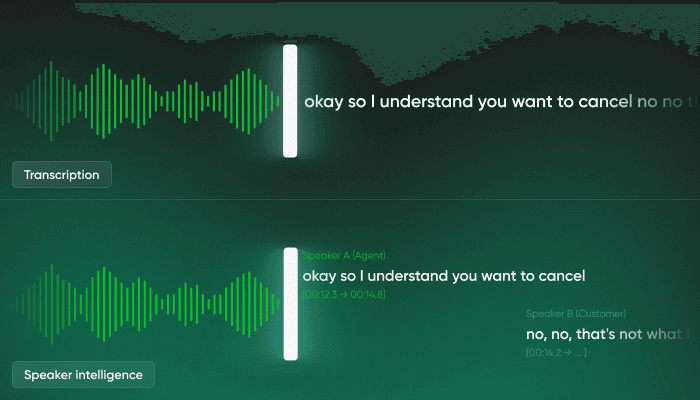
For decades, the promise of Speech-to-text (STT) has centered on one metric: word error rate (WER). Get the words right, the thinking goes, and everything else follows. But as voice AI systems move from controlled dictation tasks to real-world conversation analysis, a fundamental limitation has become impossible to ignore: transcription encodes words, not interaction.
Text is a feature of voice, not the other way around. When we reduce audio to transcription alone, we collapse a rich, multidimensional signal into a linear sequence of tokens, and in doing so, we discard the very information that makes conversations interpretable. Speaker identity, timing, overlap, prosody, and turn-taking dynamics are not recoverable from text. They must be captured directly from audio, or they are lost forever.
This article examines why transcription-only approaches fail to deliver faithful conversation understanding, even when WER is low. It explores the structural constraints of real-world audio, the conversational signals that cannot survive the text reduction, and why context must be treated as a foundational layer in any Voice AI stack, not as an afterthought.
The transcription illusion: High accuracy, low understanding
Consider this transcript from a customer service call:
okay so I understand you want to cancel no no that's not what I said I just wanted to check the options okay I see let me pull that up for you
The words are accurate. The WER might be under 5%. But without contextual signals, this transcript is nearly unintelligible:
Who said what? Is "no, no that's not what I said" the agent or the customer?
Where are the turn boundaries? Was this a smooth exchange or a heated interruption?
What happened in real-time? Did the agent talk over the customer? Did the customer interrupt in frustration?
How long did the silence last before "okay I see"? Was it a natural pause or an awkward delay?
Now consider the same interaction with diarization and timing metadata:
[00:12.3 → 00:14.8] Speaker A (Agent): "okay so I understand you want to cancel"
[00:14.2 → 00:16.9] Speaker B (Customer): "no no that's not what I said I just wanted to check the options"
[00:17.8 → 00:21.2] Speaker A (Agent): "okay I see let me pull that up for you"
Suddenly, the structure is clear. The customer interrupted the agent at 14.2 seconds, overlapping by 0.6 seconds. There was a 0.9-second gap before the agent responded. This is not just an added detail; it's the difference between misinterpreting a complaint as a question and understanding the true emotional arc of the conversation.
This is not an edge case. It is the default condition of real-world conversational audio.
Why transcription loses context: The audio reality gap
Transcription systems are trained to optimize for lexical accuracy under idealized conditions: single speakers, minimal noise, clear articulation. Real conversations operate under different rules.
Multi-speaker overlap and interruptions
In natural dialogue, speakers don't wait for silence. They anticipate turn endings, interject for clarification, and talk over each other to assert priority. Studies of spontaneous conversation show that overlapping speech occurs in 20–40% of turn transitions, and interruptions are a core mechanism of conversational control.
When two speakers overlap, STT systems face a forced choice: transcribe one voice, blend them into gibberish, or drop both. Transcription-only architectures have no mechanism to preserve the fact that two people were speaking simultaneously, a signal critical for understanding conversational dominance, engagement, and conflict.
Background noise and competing voices
Real-world audio is rarely clean. Contact centers have an open-floor ambience. Remote meetings include keyboard typing, household noise, and cross-talk from other rooms. Field recordings capture environmental sounds that compete with the target speaker.
STT models trained on clean speech struggle with these conditions, but even when they succeed, the transcript alone doesn't encode what was filtered out. If a voice AI system is analyzing a sales call and the customer's child is screaming in the background, that context matters, not just for transcription quality, but for interpreting the customer's tone, attention, and decision-making state.
Device and channel variability
Conversations happen across heterogeneous channels: phone lines, VoIP codecs, headset microphones, mobile devices, and conferencing systems. Each introduces distinct distortions: bandwidth limitations, compression artifacts, packet loss, and latency.
These channel effects don't just degrade transcription quality. They also destroy timing precision. When STT systems process audio through buffering and forced alignment, the timestamps they produce are approximations at best. Latency-sensitive signals like interruption timing, response speed, and silence duration become unreliable, rendering downstream conversational analysis impossible to trust.
Domain-specific speaking styles
Conversational speech varies wildly by domain. Legal depositions use formal turn-taking with minimal overlap. Emergency dispatch calls feature rapid, high-stress exchanges with frequent interruptions. Technical support involves long troubleshooting monologues punctuated by brief confirmations.
A transcription model trained on one domain may achieve low WER but fail to capture the interaction patterns that define another. Transcription accuracy and conversational fidelity are not the same thing.
What transcription cannot recover?
Certain conversational signals are irrecoverable once audio is reduced to text. These are not limitations of current STT models; they are structural constraints of text as a representation.
Speaker identity
Text does not encode who spoke. Without speaker diarization, multi-party conversations collapse into an undifferentiated stream of words. Downstream systems cannot attribute statements, track individual contributions, or analyze per-speaker behavior. Meeting summarization, compliance monitoring, and sales coaching all depend on knowing who said what, and transcription alone cannot provide this.
Timing and rhythm
Conversations unfold in time. The duration of a pause can signal uncertainty, disagreement, or cognitive load. The speed of a response can indicate confidence or evasiveness. The rhythm of turn-taking can reveal rapport, tension, or conversational control.
Timestamps from STT systems are often interpolated or aligned post-hoc, making them unsuitable for fine-grained temporal analysis. True conversational timing must be captured from audio directly, at the signal level, before any linguistic interpretation occurs.
Prosody and affect
Pitch, loudness, and voice quality carry meaning that text cannot represent. A flat "okay" can be agreement, resignation, or sarcasm depending on intonation. A raised voice can indicate emphasis, excitement, or anger. These signals are essential for sentiment analysis, engagement detection, and intent classification, but they are invisible in transcription.
Overlap and interaction structure
When two people speak simultaneously, the fact of overlap is itself meaningful. It signals interruption, collaboration, emphasis, or disorder. Transcription systems that drop or merge overlapping speech lose this structural information entirely. The result is not just lower accuracy, it's a fundamentally incomplete representation of the interaction.
Reframing conversation understanding as a system problem
The limitations of transcription-only approaches are not solved by better Speech-to-text models. They are solved by rethinking the architecture of Voice AI systems.
Transcription is one component of conversational understanding, not its foundation. Context: speaker identity, timing, and interaction structure must be captured before or alongside transcription, not reconstructed afterward. This requires a different approach: conversation intelligence as a foundational layer in the Voice AI stack.
Context as upstream infrastructure
In a properly architected Voice AI system, conversational metadata is extracted directly from audio and passed downstream as structured context. Speaker diarization, voice activity detection, overlap detection, and prosodic feature extraction happen at the audio processing layer, producing timestamped, speaker-attributed segments that downstream models can reason about.
This approach has several advantages:
Fidelity: Contextual signals are captured before information is lost to transcription.
Modularity: STT, natural language understanding (NLU), and analytics can operate on structured, speaker-aware input rather than raw text.
Robustness: Systems degrade gracefully when transcription quality is poor, because conversational structure is preserved independently.
Complementing STT, not competing
Conversation intelligence is not a replacement for transcription; it is a prerequisite for making transcription useful. STT systems are optimized for lexical accuracy, not conversational structure. Diarization and timing models are optimized for interaction fidelity, not words. Both are necessary. Neither is sufficient alone.
The most effective Voice AI systems treat these as complementary layers:
Audio preprocessing: Noise suppression, channel normalization
Conversation intelligence: Speaker diarization, overlap detection, voice activity detection
Transcription: STT with speaker-attributed, timestamped segments
Understanding: NLU, sentiment, intent, and analytics on contextualized text
This architecture ensures that downstream models always have access to the full conversational signal, not just its lexical shadow.
pyannoteAI: The context foundation layer
pyannoteAI is designed to provide this foundational conversation intelligence layer. It extracts speaker, timing, and interaction signals directly from audio, structuring conversations before they are reduced to text.
What pyannoteAI provides
Speaker diarization: Identifies who spoke when, with millisecond-level precision
Overlap detection: Captures simultaneous speech and interruption events
Voice activity detection: Segments speech from silence, preserving timing structure
Embedding and clustering: Tracks speaker identity across sessions and channels
These signals are provided as structured metadata that downstream systems can consume directly, whether for STT alignment, NLU context enrichment, or analytics.
Why it matters
In real-world voice AI deployments, conversational context is not optional. Contact centers need to attribute compliance violations to specific agents. Meeting platforms need to track speaking time and engagement. Sales coaching tools need to identify interruption patterns and conversational dominance. None of this is possible with transcription alone.
pyannoteAI makes these use cases tractable by solving the context problem upstream, so that every component in the Voice AI stack (transcription, understanding, analytics) operates on a faithful representation of the conversation, not a lossy approximation.
Conclusion: Text is a feature of voice
Transcription converts audio into words, but conversations are not just words. They are structured interactions shaped by speakers, timing, interruptions, and vocal dynamics. In real-world audio conditions, transcription-only systems lose critical information that cannot be reconstructed downstream.
Accurate conversation analysis requires a foundation layer that captures context directly from audio. pyannote.ai provides this layer, structuring conversational signals before meaning is reduced to text, enabling Voice AI systems to reason about interactions, not just interpret words.
Because in the end, text is a feature of voice. Not the other way around.
