Blog

The Voice AI stack has converged on a familiar sequence: capture audio, transcribe it, send the text to an LLM model, return a response or a report. Every layer in that sequence has improved. Word error rates on clean English audio are low enough that vendors now compete over tenths of a point.
Production systems still break, and they break in predictable places. The support call where an objection is credited to the wrong party. The meeting where four people share one microphone. The voice agent that hands off to a human mid-call, after which every latency metric silently inverts. The Japanese meeting where a short acknowledgment is read as a new speaker turn.
None of these are transcription failures. They are failures of speaker context, and no amount of additional word accuracy will fix them. The layer that resolves them is speaker intelligence, and it is still missing from most pipelines.
What is speaker intelligence?
Speaker intelligence covers the set of models and signals used to analyze, structure, and extract meaning from voice conversations. Where speech-to-text answers what was said, speaker intelligence answers who said it, when, to whom, and under what acoustic conditions. It turns an audio file into structured conversational data rather than a flat block of text.
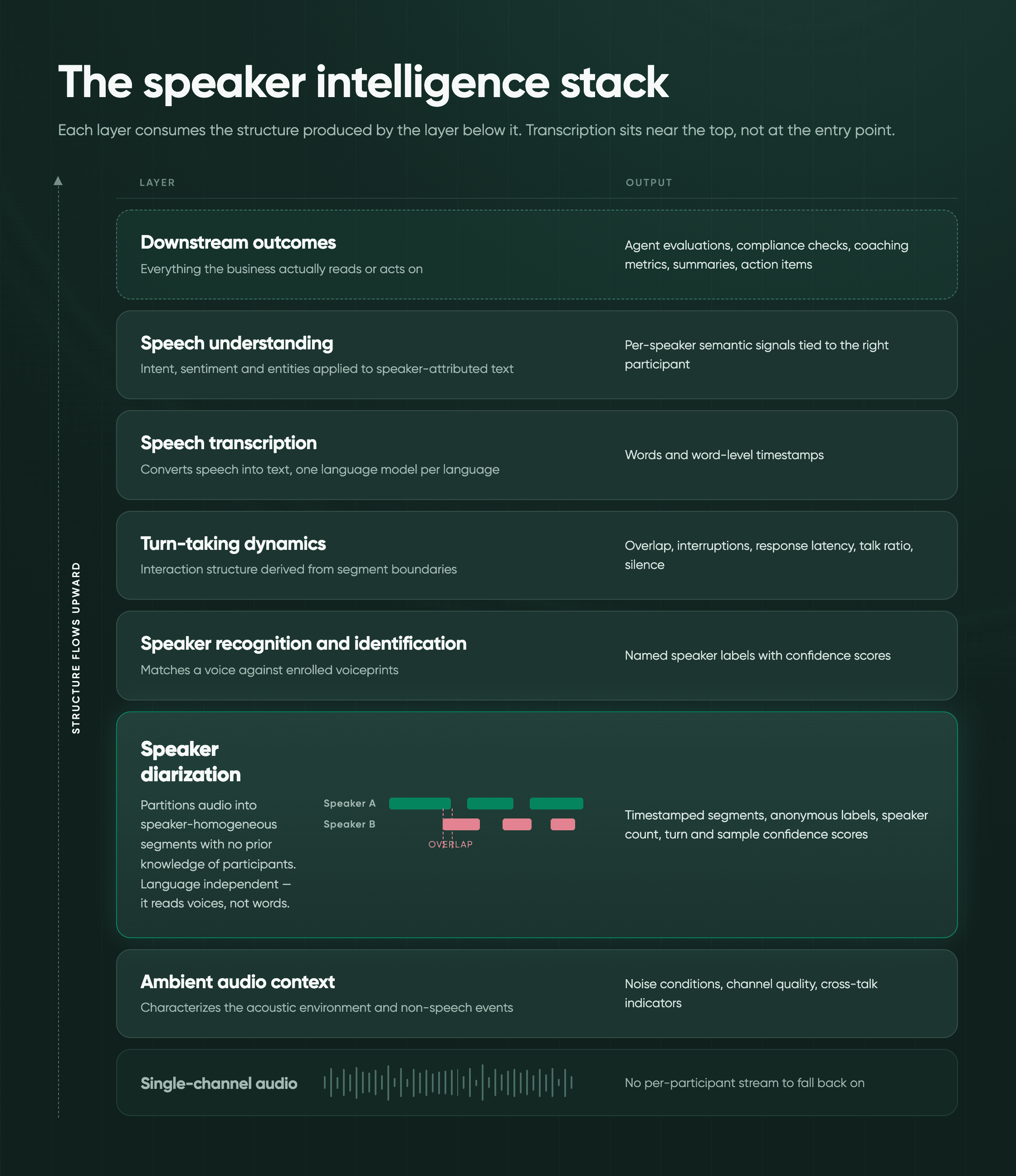
It is not a single model. It is a stack of complementary layers, each producing a distinct output that downstream systems can consume.
Layer | Function | Output |
|---|---|---|
Speaker diarization | Partitions audio into speaker-homogeneous segments with no prior knowledge of the participants | Timestamped segments with anonymous labels, plus a speaker count |
Speaker recognition and identification | Matches a voice against enrolled voiceprints to attach a known identity | Named speaker labels with confidence scores |
Turn-taking dynamics | Derives interaction structure from segment boundaries | Overlap, interruptions, response latency, talk ratio, silence distribution |
Speech understanding | Applies intent, sentiment, and entity extraction to speaker-attributed text | Per-speaker semantic signals |
Ambient audio context | Characterizes the acoustic environment and non-speech events | Noise conditions, channel quality, cross-talk indicators |
Speech transcription | Converts speech into text | Words and word-level timestamps |
The order matters. Transcription sits at the end of that list, not the start. When diarization runs first, or at minimum runs on the audio rather than on the transcript, every layer above it inherits a reliable structure. When it runs last or not at all, errors propagate: a misattributed segment corrupts the turn-taking metrics, which corrupt the evaluation logic, which corrupts the report a customer reads. We covered that cascade in detail in Why conversational context is the real performance driver for your Voice AI stack.
The business outcome of getting this right is not a better transcript. It is a set of measurements that hold up: who interrupted whom, how long the agent took to respond, whether the required disclosure was made by the person legally required to make it, and which of the eight people in a room approved the decision.
Key business benefits of speaker intelligence
Observability for voice agents
Voice agent platforms are evaluated on deterministic metrics: latency, interruption rate, handoff behavior, turn duration. Every one of those metrics is computed from speaker boundaries. If the boundaries are wrong, the metrics are not slightly noisy; they are meaningless.
This is the constraint Bluejay ran into. Their testing and observability platform ingests audio, transcripts, tool calls, and traces, then runs both deterministic and LLM-based evaluations across millions of conversations a year. Before integrating pyannoteAI, diarization was unreliable on single-channel recordings with multiple speakers, which is the standard case when an AI agent hands off to a human, when an IVR voice changes mid-call, or when participants talk over each other. As their CEO put it, if speaker attribution is wrong, the value of the evaluations goes to zero.
Two implementation details from that integration are worth noting. Bluejay runs diarization before transcription, and they use pyannoteAI timestamps rather than STT timestamps for interruption detection and latency measurement. Word-level timestamps from an ASR model are aligned to lexical output, not to the acoustic boundary of a turn. For measuring who spoke over whom, the difference is decisive.
Compliance and quality assurance
Regulatory requirements are almost always speaker-scoped. The agent must state the disclosure. The clinician must obtain consent. The advisor, not the client, must deliver the risk statement. A compliance check that runs on an unattributed transcript can confirm that a phrase appeared somewhere in the call, which is not the same claim.
The same applies to QA scoring. Talk ratio, monologue length, and interruption frequency are standard coaching metrics in contact centers, and all three are derived entirely from diarization output. Precision-2 returns timestamps at hundredth-of-a-second resolution and exposes confidence scores at both turn and sample level, which makes it possible to route low-confidence segments to human review rather than scoring them blindly.
Languages other than English
This is where the gap is widest and least discussed. Speech-to-text quality is a function of training data, and training data is heavily skewed toward English. When you build for Japanese, Mandarin, Arabic, or a regional variant of any of them, transcription quality drops and the conversational conventions of the language start to interfere with the pipeline.
Diarization behaves differently. It operates on speaker-discriminative acoustic representations rather than lexical content, which makes it structurally language-independent. That property is worth exploiting deliberately: in a pipeline where the STT model is the weakest link for a given language, the speaker layer stays reliable and can be used to constrain and correct what sits above it.
The language-specific challenge is conversational structure rather than vocabulary. Notta, one of the most widely adopted meeting productivity platforms in Japan with 15 million users, runs into this constantly. Japanese conversation uses frequent short backchannels, aizuchi such as はい, うん, and なるほど, far more often than English does. A system not built for it reads each one as a speaker change. Structured turn-taking with short utterances also demands tighter precision on turn boundaries. Add the Notta Memo recorder, a pocket device capturing an entire conference room through a single shared stream with no per-participant audio, and there is nothing to fall back on except the diarization model itself.
The measurable pattern matches the argument. Precision-2 delivers a 28 percent average relative reduction in diarization error rate over Community-1 across six public benchmarks, with a range of 15 to 47 percent. The largest gains are concentrated in difficult, multi-speaker, non-English material: 47 percent on MagicData-RAMC and 31 percent on AliMeeting, both Mandarin conversational corpora. Easy audio was already close to solved. The gains show up exactly where production systems fail.
Speaker intelligence use cases across industries
The three benefits above show up differently depending on what the audio is and who reads the output. The pattern is consistent: wherever a conversation involves more than one participant on a single stream, and wherever a decision depends on knowing which of them said something, the speaker layer stops being an enhancement and becomes a dependency. What changes from one industry to the next is the cost of getting the attribution wrong.
Healthcare documentation. Clinician and patient separation, which determines whether a symptom statement enters the record as reported or as asked about.
Meeting intelligence and productivity. Attribution of decisions, action items, and commitments in rooms where several participants share one device.
Media, dubbing, and localization. Per-speaker segmentation as the input to voice cloning and multilingual dubbing pipelines.
Legal, public sector, and regulated environments. Verbatim attribution in hearings and council sessions.
Contact centers and CX platforms. Agent versus customer attribution, talk ratio, compliance verification, escalation detection on single-channel recordings.
Voice agent and evaluation platforms. Latency, interruption, and handoff metrics that survive an AI-to-human transition mid-call.
Getting started, and what to consider
Adding a speaker layer to an existing pipeline is a smaller change than most teams expect. Bluejay went from initial testing to production in under four days, and the integration surface is a single API call returning a segmented timeline. The decisions that determine whether it works are made before that call, not after it: which audio you evaluate against, where the layer sits relative to transcription, and which model matches your deployment constraints.
Benchmark on your own audio. Public DER figures indicate direction, not what you will observe. Run a representative sample of your worst production audio, single-channel, overlapping, accented, noisy, and measure against your own reference annotations.
Match the model to the constraint. Community-1 is open source, self-hosted, batch, free, and the only fine-tunable option. Precision-2 covers batch and streaming, adds voiceprints and speaker identification, confidence scores, and STT orchestration, and runs as a cloud API, on-premises, at the edge, or air-gapped. Live-1 handles the real-time path.
Treat voiceprints as biometric data. A voiceprint can be created from around ten seconds of audio, with ten to thirty seconds recommended for reliable named recognition, and it enables tracking the same person across sessions. That capability requires consent from the people whose voices you enroll. pyannoteAI does not store voiceprints, and identification is available in batch with Precision-2.
The argument is narrower than it looks. Transcription quality is approaching diminishing returns, and the remaining failures in production Voice AI are structural rather than lexical. Adding a speaker intelligence layer is one of the few changes that improves diarization, transcription, attribution, and every downstream evaluation at the same time, because all of them consume the same structure. For a longer treatment of why transcript-only analysis falls short, see Context accuracy: why transcription isn't enough to analyze conversations.
FAQ
What is the difference between speaker intelligence and conversational AI?
Conversational AI generates and manages dialogue. Speaker intelligence structures and measures it. A voice agent built with conversational AI still needs a speaker layer to know whether it was interrupted, by whom, and how long it took to respond.
How quickly are insights available?
It depends on the path. Batch diarization runs on completed recordings, with Precision-2 processing roughly 1 hour of audio in less than a minute. Streaming diarization with Live-1 emits labels within about 300 milliseconds, which is the requirement for anything that has to act during the call rather than after it.
What are the first steps of adding speaker intelligence?
Run your hardest production audio through a diarization API and compare the output against your own annotations. Then decide whether the layer runs before transcription or as post-processing, based on which metrics have to be exact. Both patterns are in production today.
How is ROI measured for speaker intelligence?
Through the metrics that depend on attribution rather than through DER alone. Reduction in support tickets caused by misattribution, reduction in manual QA and debugging time, compliance checks that pass audit, and evaluation outputs stakeholders act on without re-listening to the call.
Should I prioritize real-time or batch for speaker intelligence?
Batch first, unless the product acts during the conversation. Batch is where analytics, compliance, and QA live, and where accuracy is highest. Add streaming when the use case is live routing, barge-in handling, or real-time flagging.
Speaker intelligence is not a replacement for your STT or your LLM. It is the layer they are missing. You can test it on your own audio with a 30-day trial, or read the documentation to see how the API fits your current pipeline.
