Most accurate diarization model
Precision-3
Precision-3
Fewer wrong speaker labels reaching your pipeline, and the controls to handle the ones that remain. Tune the model to your audio, decide by frame what to trust.
40 to 67%
Lower diarization error than the best commercial alternative on each benchmark
14.35 DER
10.4% lower than Precision-2, and 34% lower than Community-1, across 15 datasets
3
speed-to-accuracy modes for on-premises deployment.
Why Precision-3
Accurate who spoke when
Accurate who spoke when
Accurate who spoke when
Better diarization by default, adjustable when the default is not enough. Precision-3 cuts diarization error by 10.4% versus Precision-2 and gives you the parameters to tune what is left.
Better diarization by default, adjustable when the default is not enough. Precision-3 cuts diarization error by 10.4% versus Precision-2 and gives you the parameters to tune what is left.
Better performance, stronger accuracy
No trade-off by default: 14.35 average DER. The model is getting better at deciding who is speaking, not only at deciding whether someone speaks.
Controllable diarization
Two sensitivity parameters, 'vadSensitivity' and 'crosstalkSensitivity', now decoupled from the output scores, to tune one, and don't distorts the other.
Interpretable output for production logic
'speakerProbability', 'speechProbability', and 'crosstalkProbability', each answers a single question, so you can filter, route, and threshold on them.
Deployment-level control
On-premises teams pick the profile that matches their latency and quality budget: accuracy, balance, or speed.
Benchmark
Bring the accuracy before anything else runs
Bring the accuracy before anything else runs
Bring the accuracy before anything else runs
Diarization error rate measured against the commercial diarization and speaker-attribution results of every provider we could run. Lower is better.
Diarization error rate measured against the commercial diarization and speaker-attribution results of every provider we could run. Lower is better.
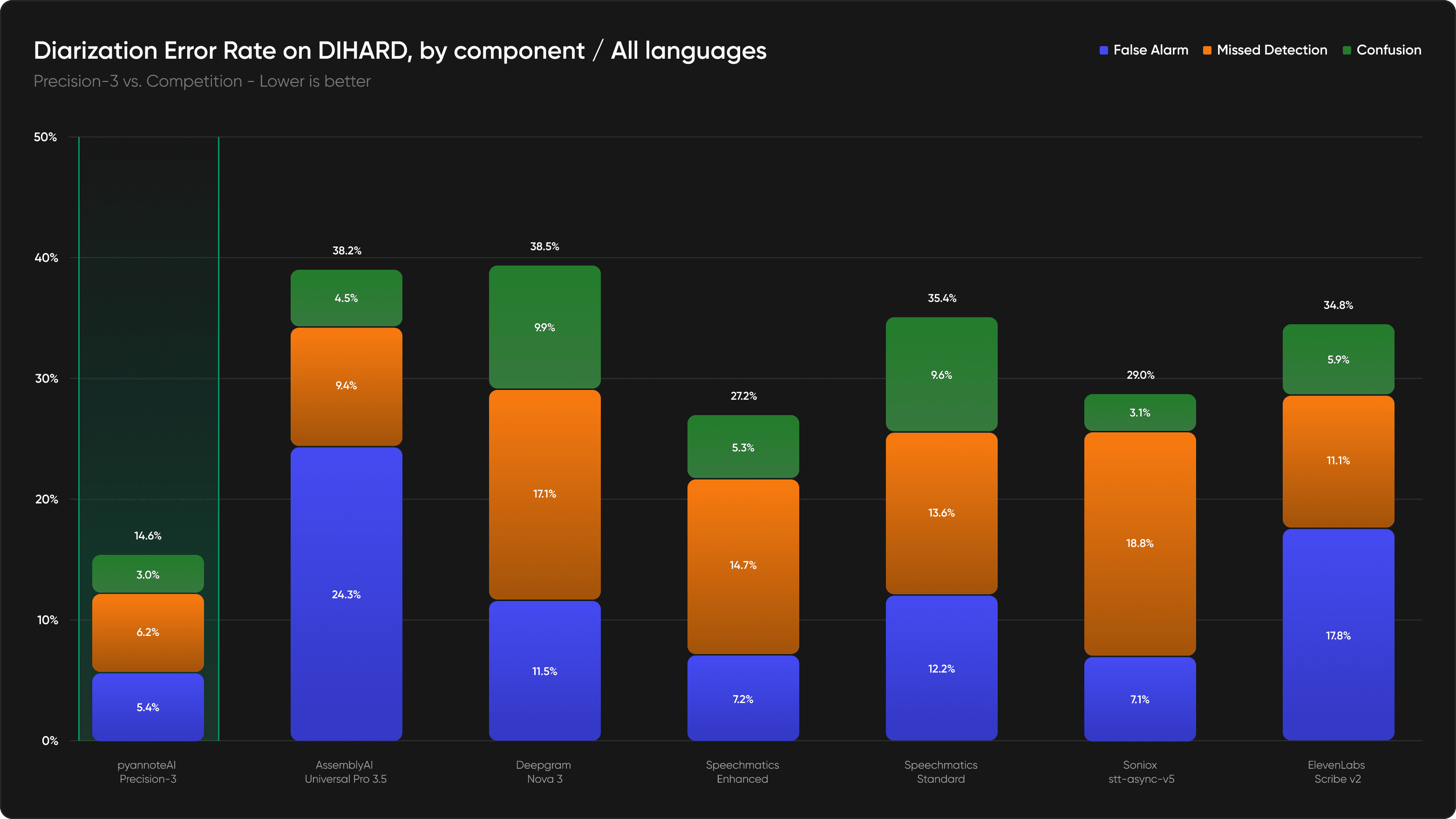
Against the strongest commercial alternative on each dataset, Precision-3 lands between 40 and 67% lower. Against the field average, between 56 and 74%.
Against the strongest commercial alternative on each dataset, Precision-3 lands between 40 and 67% lower. Against the field average, between 56 and 74%.
Bring the accuracy before anything else runs
Bring the accuracy before anything else runs
Mode
Mode
Precision-3
Precision-3
Precision-2
Precision-2
Gain
Gain
Accuracy
Accuracy
14.35
14.35
16.02
16.02
1.67 points, 10.4%
1.67 points, 10.4%
Balance
Balance
14.94
14.94
16.31
16.31
1.37 points, 8.4%
1.37 points, 8.4%
Speed
Speed
15.52
15.52
16.91
16.91
1.39 points, 8.2%
1.39 points, 8.2%
Average DER over 15 datasets. Every mode improves, so there is no configuration where you stay on the previous generation's quality.
Average DER over 15 datasets. Every mode improves, so there is no configuration where you stay on the previous generation's quality.
Speaker-attributed transcription
Speaker-attributed transcription

Average DER over 15 datasets. Every mode improves, so there is no configuration where you stay on the previous generation's quality.
Average DER over 15 datasets. Every mode improves, so there is no configuration where you stay on the previous generation's quality.
Bring accuracy where your Voice AI fails in production
Bring accuracy where your Voice AI fails in production
Most speech models fail in the real world, where conversations involve multiple speakers, overlaps, and background noise. pyannoteAI adds a speaker intelligence layer that powers accurate transcriptions, context-aware voice agents, and reliable analytics.
Most speech models fail in the real world, where conversations involve multiple speakers, overlaps, and background noise. pyannoteAI adds a speaker intelligence layer that powers accurate transcriptions, context-aware voice agents, and reliable analytics.
01
Audio Input
Audio Input
02
Speaker Intelligence
Speaker Intelligence
(Diarization)
(Diarization)
03
Transcription
Transcription
04
Business Logic
Business Logic
(LLMs)
(LLMs)
05
Text to Speech
Text to Speech
06
Audio Output
Audio Output
Diarization errors are inherited by every downstream step. A wrong speaker label at step 02 becomes a wrong transcript at step 03, wrong context at step 04, and a voice agent that answers the wrong person at step 06.
Diarization errors are inherited by every downstream step. A wrong speaker label at step 02 becomes a wrong transcript at step 03, wrong context at step 04, and a voice agent that answers the wrong person at step 06.
Built for developers
State-of-the-art
Same request, new parameters
Discover the power of speaker diarization
Precision-3 runs on the endpoint you already call. Sensitivity parameters and Probability outputs are opt-in fields on the same request and response.
Our AI speaker diarization models accurately identify and separate speakers in audio recordings, providing valuable insights and improving productivity.
Documentation
Precision-3 reference
Quickstart
Diarize your first file
Tutorial
Tune vadSensitivity and crosstalkSensitivity
Tutorial
Filter and route on frame-level probabilities
Tutorial
Combine Precision-3 with your STT provider
Migration
Move from confidence to speakerProbability
Changelog
Precision-3 release notes
curl
1
2
3
4
5
6
7
8
9
1
2
3
4
5
6
7
8
9
Curl --request POST
--url https://api.pyannote.ai/v1/diarize \
--header ‘Authorisation: Bearer <token>’ \
--data ‘{
“url”: "https://files.pyannote.ai/marklex1min.wav",
"model": "precision-3",
"vadSensitivity": 0,
"crosstalkSensitivity": 0
}’
Curl --request POST
--url https://api.pyannote.ai/v1/diarize \
--header ‘Authorisation: Bearer <token>’ \
--data ‘{
“url”: "https://files.pyannote.ai/marklex1min.wav",
"model": "precision-3",
"vadSensitivity": 0,
"crosstalkSensitivity": 0
}’
Frequently Asked Questions
Explore how Precision-3 will make every conversation understandable
What is Precision-3?
Precision-3 is pyannoteAI's batch speaker diarization model. It takes an audio file and returns who spoke when, with speaker labels, segment boundaries, and per-frame probabilities. It averages 14.35 DER across 15 public benchmarks, a 10.4% relative reduction against Precision-2, and adds two input sensitivity parameters and three probability outputs. It runs at the same price as Precision-2.
What is speaker diarization?
Speaker diarization is the task of segmenting an audio recording by speaker: detecting when someone is speaking, grouping those segments by voice, and assigning a consistent label to each participant. It answers who spoke when, without knowing in advance who the speakers are or how many there are. It runs before transcription, and it determines whether a speaker-attributed transcript is usable.
How does Precision-3 compare to other diarization models on the market?
On five public benchmarks, Precision-3 records between 40 and 67% lower diarization error than the strongest commercial alternative on each dataset, and between 56 and 74% lower than the field average. On control, every STT provider outputs a per-word confidence score and some expose a speaker count sensitivity. Precision-3 is the only model that combines diarization-specific probabilities with input sensitivity controls at this level of granularity.
What happens to Precision-2?
On-premises, Precision-3 comes with a package update: the new version has to be deployed before the model is available to your workloads. On the API, Precision-3 will first be available but not default, then become the default, and then Precision-2 is deprecated. Precision-2 stays available throughout the migration window. Existing API requests keep their current behaviour until Precision-3 becomes the default, and no code change is required to get the accuracy gain. The new parameters and outputs are opt-in.
How do I integrate Precision-3 in my Voice AI pipeline?
Precision-3 sits between your audio input and your STT provider. Send the audio to the diarization endpoint, then align the returned speaker segments with your transcript, or use STT orchestration to get both in a single call. If you already call the pyannoteAI API, the integration is the same request. On-premises, you select the operating mode at deployment time. The sensitivity parameters and probability outputs are additional fields on the same request and response.
What languages does Precision-3 support?
Precision-3 works on acoustic and speaker characteristics rather than on words, so it is not tied to a language or a vocabulary. The benchmark set covers Mandarin (AISHELL, AliMeeting), French (INA), English meeting and broadcast audio (AMI, AMI-SDM, NOTSOFAR, DIHARD), and multilingual telephone speech (CALLHOME). It also handles code-switching and multilingual conversations, since no language model is involved in the speaker decision.
Frequently Asked Questions
Explore how Precision-3 will make every conversation understandable
What is Precision-3?
Precision-3 is pyannoteAI's batch speaker diarization model. It takes an audio file and returns who spoke when, with speaker labels, segment boundaries, and per-frame probabilities. It averages 14.35 DER across 15 public benchmarks, a 10.4% relative reduction against Precision-2, and adds two input sensitivity parameters and three probability outputs. It runs at the same price as Precision-2.
What is speaker diarization?
Speaker diarization is the task of segmenting an audio recording by speaker: detecting when someone is speaking, grouping those segments by voice, and assigning a consistent label to each participant. It answers who spoke when, without knowing in advance who the speakers are or how many there are. It runs before transcription, and it determines whether a speaker-attributed transcript is usable.
How does Precision-3 compare to other diarization models on the market?
On five public benchmarks, Precision-3 records between 40 and 67% lower diarization error than the strongest commercial alternative on each dataset, and between 56 and 74% lower than the field average. On control, every STT provider outputs a per-word confidence score and some expose a speaker count sensitivity. Precision-3 is the only model that combines diarization-specific probabilities with input sensitivity controls at this level of granularity.
What happens to Precision-2?
On-premises, Precision-3 comes with a package update: the new version has to be deployed before the model is available to your workloads. On the API, Precision-3 will first be available but not default, then become the default, and then Precision-2 is deprecated. Precision-2 stays available throughout the migration window. Existing API requests keep their current behaviour until Precision-3 becomes the default, and no code change is required to get the accuracy gain. The new parameters and outputs are opt-in.
How do I integrate Precision-3 in my Voice AI pipeline?
Precision-3 sits between your audio input and your STT provider. Send the audio to the diarization endpoint, then align the returned speaker segments with your transcript, or use STT orchestration to get both in a single call. If you already call the pyannoteAI API, the integration is the same request. On-premises, you select the operating mode at deployment time. The sensitivity parameters and probability outputs are additional fields on the same request and response.
What languages does Precision-3 support?
Precision-3 works on acoustic and speaker characteristics rather than on words, so it is not tied to a language or a vocabulary. The benchmark set covers Mandarin (AISHELL, AliMeeting), French (INA), English meeting and broadcast audio (AMI, AMI-SDM, NOTSOFAR, DIHARD), and multilingual telephone speech (CALLHOME). It also handles code-switching and multilingual conversations, since no language model is involved in the speaker decision.