Our latest diarization model, Precision-3, is available now on the API and for on-premises deployments.
Added
Two new input parameters:
vadSensitivityandcrosstalkSensitivity. They adjust voice activity and overlap detection independently of one another.Three new output scores:
speakerProbability,speechProbability, andcrosstalkProbability. Each answers one question: is this speaker active, is speech present, is there crosstalk.Three on-premise operating modes:
speed,balance, andaccuracy. Each sets a different trade-off between processing speed and diarization quality.
Changed
Average diarization error rate drops 10.4% against
Precision-2, from 16.02 to 14.35 DER across 15 benchmark datasets. Over half of that improvement (53%) comes from more accurate speaker attribution: the model assigns speech to the wrong speaker 18.7% less often.On-premise,
vadSensitivityreplacesvad_aggressivenessand inverts the scale: high sensitivity now means more speech detected, where high aggressiveness previously meant the opposite.
Deprecated
The frame-level
confidenceoutput is deprecated in favor ofspeakerProbability,speechProbability, andcrosstalkProbability.turnLevelConfidenceis unchanged.
Benchmark results:
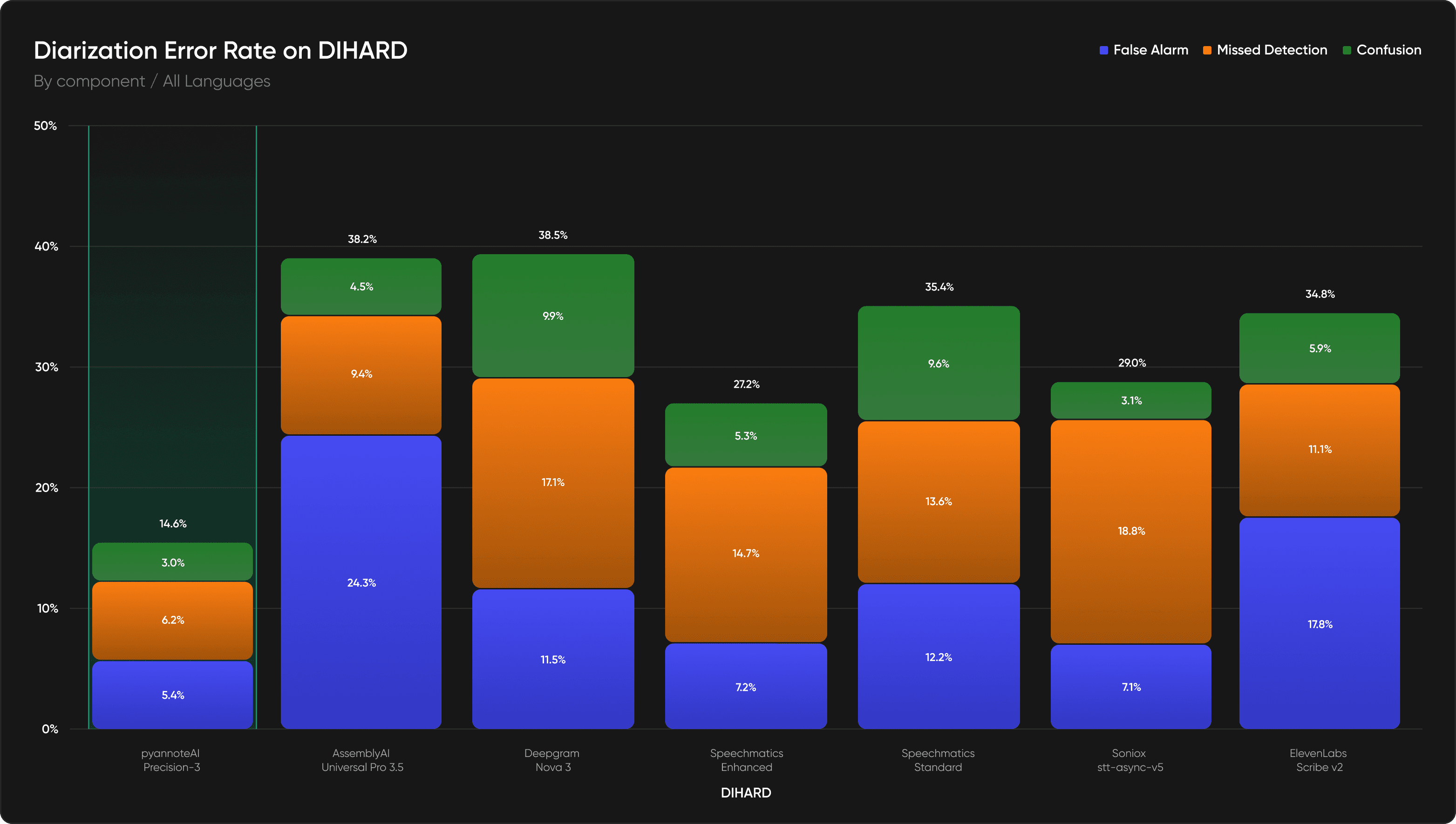
Pricing is unchanged. Existing integrations keep running Precision-2 until you set model: "precision-3" or wait for the default switch on October 1. Precision-2 is deprecated on October 15.
📒 Read more about Precision-3 in our blogpost
🔎 Explore the technical tutorials to deploy Input parameters and Output scores
⛳️ Follow the migration guide from Precision-2 to Precision-3
📹 Check your guide video tutorial
