Voice Model Training

Better data beats a bigger model. Every time.

Speaker-level annotation, overlap detection, and quality scoring... pyannoteAI is how leading voice AI teams turn millions of messy audio hours into clean, training-ready datasets without manual labeling pipelines.

Voice Model Training

Better data beats a bigger model. Every time.

Speaker-level annotation, overlap detection, and quality scoring... pyannoteAI is how leading voice AI teams turn millions of messy audio hours into clean, training-ready datasets without manual labeling pipelines.

Voice Model Training

Better data beats a bigger model. Every time.

Speaker-level annotation, overlap detection, and quality scoring... pyannoteAI is how leading voice AI teams turn millions of messy audio hours into clean, training-ready datasets without manual labeling pipelines.

Trusted by 200k+ developers worldwide

Trusted by 200k+ developers worldwide

Train data to build smart Voice and Language models

Train data to build smart Voice
and Language models

Train data to build smart Voice and Language models

Every team training voice models encounters the same challenge: their corpus is filled with overlapping speech, unlabeled speakers, and silent or noisy segments. Manual annotation doesn't scale. We built the alternative.

Every team training voice models encounters the same challenge: their corpus is filled with overlapping speech, unlabeled speakers, and silent or noisy segments. Manual annotation doesn't scale. We built the alternative.

Cut annotation costs

Automated speaker labeling replaces manual annotation workflows. Reduce human review time by a factor of ten.

Higher model accuracy downstream

Cleaner, well-segmented training data leads to measurable improvements on ASR, TTS, and speaker verification benchmarks.

Language-agnostic curation

Apply the same diarization pipeline to any language, any acoustic condition. One workflow for a global corpus.

Quality scoring built in

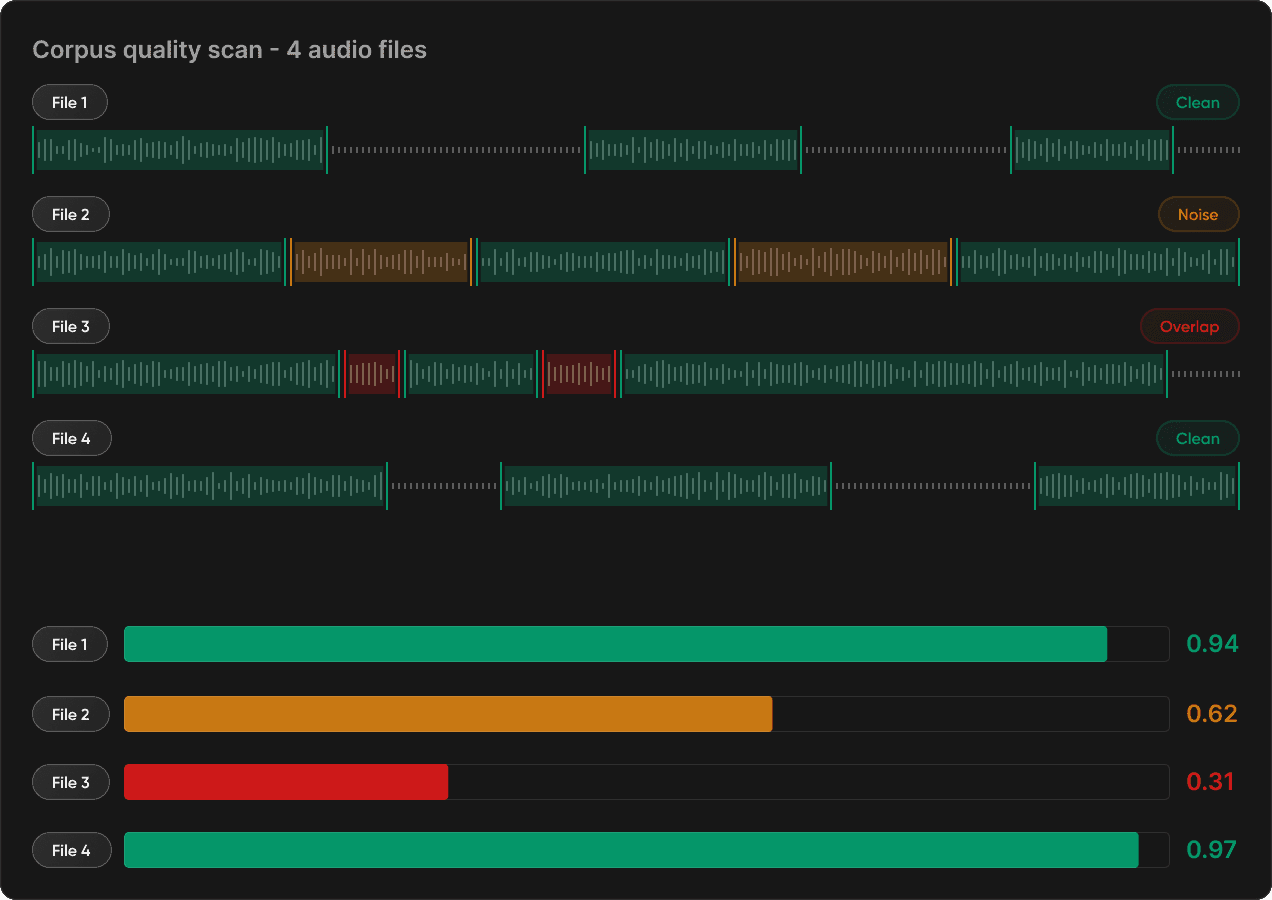
Confidence scores let you rank and prioritize the cleanest samples. Stop training on garbage you didn't know was there.

Use cases

Where pyannoteAI fits in the ML workflow.

Where pyannoteAI fits in the ML workflow.

Different models, same prerequisite: clean, speaker-attributed training data. Here's how pyannoteAI delivers it.

Different models, same prerequisite: clean, speaker-attributed training data. Here's how pyannoteAI delivers it.

Dataset curation: Automatically filter overlapping speech, background noise, and low-quality segments from large-scale audio corpora.

Speaker-level annotation: Generate per-speaker labels and timestamps at scale, replacing manual annotation.

Quality scoring: Use confidence scores to rank and prioritize clean samples, reducing the "garbage in, garbage out" problem.

Evaluation & benchmarking: Measure model output against speaker-attributed ground truth.

Voice agent evaluation: Quantify turn-taking, latency, and consistency in production voice agents

Features

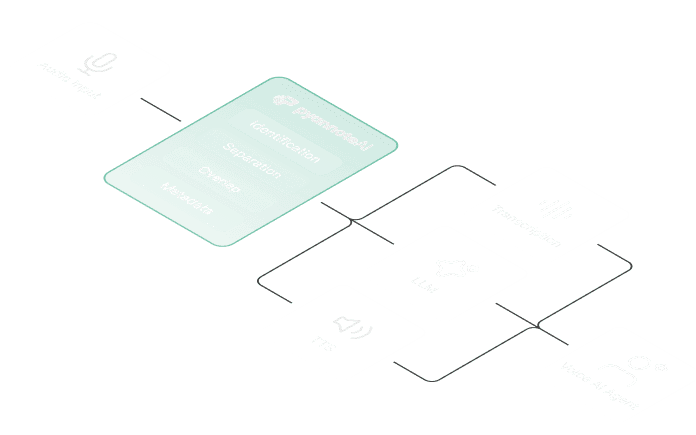
A research-grade pipeline, available as an API.

Speaker intelligence,not just transcription.

A research-grade pipeline, available as an API.

Speaker diarization

The same models cited in published research, with accurate results.

Voice activity detection

Strip silence, ambient noise, and non-speech regions.

Overlapping speech detection

Flag segments that would corrupt your training.

Confidence score

Surface which annotations to trust, which to drop.
Built by researchers, used by teams building the most used models.

Built by researchers, used by teams
building the most used models.

Built by researchers, used by teams building the most used models.

OSS Heritate

OSS Heritate

pyannote.audio is the most-used speaker diarization libraries

+M training hours

+M training hours

Production-tested at corpus scale

Multilingual

Multilingual

Proven across major language families

Train on the data your model deserves.

Train on the data your model deserves.

Curate, annotate, and quality-score corpora at scale, without an annotation team.