Blog

Legal work produces enormous amounts of recorded speech. Depositions run for hours. Hearings and arbitrations are recorded as a matter of course. Investigations generate stacks of interviews. And when any of it gets transcribed, the transcript's value hangs on one thing that has nothing to do with spelling: does every statement carry the right name?
That's the question speaker diarization answers. It analyzes the audio itself, the voices rather than the words, to determine who spoke when, so a transcript reads as attributed testimony instead of an anonymous wall of text. This article covers what that makes possible for legal teams, why accuracy is harder than it sounds on real legal audio, and how it works when recordings can't leave your infrastructure.
In legal audio, attribution is the value
A meeting transcript with shaky speaker labels is annoying. A deposition transcript with shaky speaker labels is a different kind of problem, because in legal work the whole point of the record is who said it. A statement is testimony from the witness, a question from counsel, or an objection from opposing counsel, and those are three different things even when the words are identical. Talk-time tells you who controlled an interview. The disputed sentence matters precisely because of whose mouth it came from.
This is why generic transcription falls short for legal use even when the words are perfect. Transcription answers what was said. Legal work runs on who said it, and that answer lives in the audio, in the voices, which is exactly the layer diarization works on.
What speaker diarization makes possible
Attributed transcripts of depositions and hearings. Diarization segments the recording by voice, so every question, answer, and interjection carries a speaker label with precise timing. Paired with your transcription engine through STT Orchestration, the output is a speaker-attributed transcript in one step, and the attribution comes from the audio rather than guessed from the words.
Structure across hours of interviews. An investigation with a dozen recorded interviews becomes a searchable, structured dataset: every statement tied to a speaker and a timestamp, talk-time per participant, and the ability to pull everything one person said across a recording in seconds instead of scrubbing audio by hand.
Recognizing recurring speakers. With voiceprints, the platform goes beyond "Speaker 1" and identifies known voices by name, so the same deponent, counsel, or interviewer is recognized across sessions and recordings rather than relabeled from scratch each time. A voiceprint is built from a short clean sample of a single speaker, at most 30 seconds with no overlapping voices, and multiple voiceprints can be passed into one identification request, each with its own label. A confidence threshold sets how strict a match has to be, and exclusive matching prevents two speakers in the same recording from resolving to the same person, which earns its keep when counsel and a witness share a channel or an accent. The output pairs diarization segments with identification matches and confidence scores, so a reviewer sees both the attribution and how certain it is. The voiceprints themselves stay with the firm: job outputs including voiceprints are deleted 24 hours after the job completes, so the team retrieves them and holds them in its own system for reuse across matters.
Review at e-discovery scale. When the matter includes hours of audio, speaker structure is what makes triage possible: filter to one voice across a corpus, skip the silence, and route only the relevant segments to human review.
Why legal audio is genuinely hard
Legal proceedings are an adversarial acoustic environment, and that's not a joke about the lawyers. Objections are interruptions by design, and interruptions mean overlapping speech: in natural conversation, overlap shows up in 20 to 40 percent of turn transitions, and contested proceedings sit at the high end. Recording conditions vary wildly, from a properly miked courtroom to a phone in the middle of a conference table. Participants change, join late, and speak briefly. Voices under stress don't sound like voices at rest.
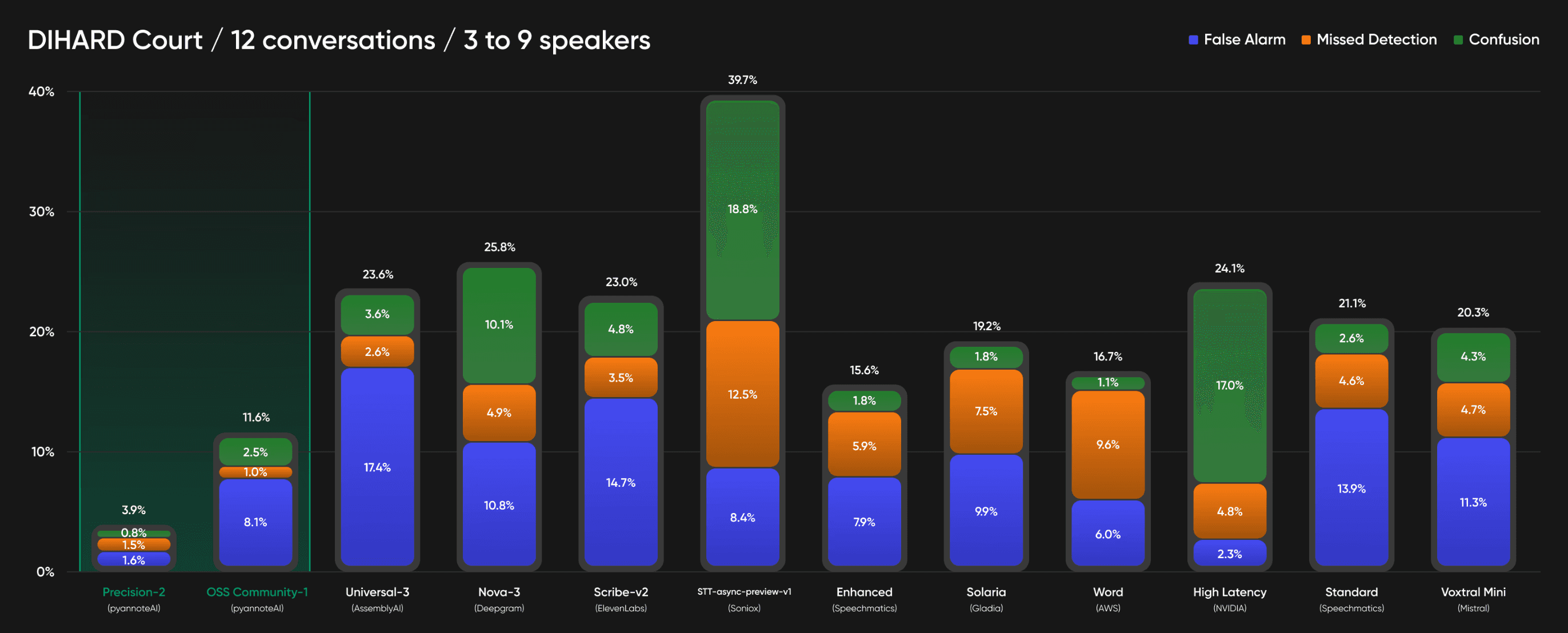
These are exactly the conditions where diarization quality separates. Overlap-aware models attribute both speakers through an interruption instead of losing one. Robustness to noise and channel keeps the same voice labeled consistently from the first hour to the fourth. On the public benchmark, which includes courtroom audio as one of its ten domains, Precision-2 posts the lowest speaker attribution error rate in every domain tested, and the methodology is published so the claim can be checked rather than taken on faith.
Confidential by design
Legal recordings are confidential, so the deployment model matters, and here the answer is simple. pyannoteAI processes audio without storing it, and customer audio is never used to train models. For firms and legal-tech vendors whose recordings can't leave their environment at all, the models deploy on your own infrastructure, so the audio is processed where it already lives, and the vendor never sees it. pyannote is a French company built on more than a decade of public research, which for European legal teams means the provider sits in the same legal order they do. That's the whole pitch, and the sovereign deployment hub covers the deployment tiers in detail.
Getting started
The practical path is short. Run recordings through the API to get speaker-attributed segments, or use STT Orchestration to get a full speaker-attributed transcript with the transcription engine you already use. When participant counts are known, and in legal settings they usually are, pass the speaker count or its range and accuracy improves further, since the system no longer has to estimate how many voices are in the room. Teams with residency requirements start the enterprise conversation for on-premise deployment.
Frequently asked questions
How do legal teams use speaker diarization? To turn recorded depositions, hearings, and interviews into speaker-attributed transcripts and searchable, structured records: every statement tied to a voice and a timestamp, talk-time per participant, and fast retrieval of everything one person said.
Can AI identify who is speaking in a deposition recording? Diarization separates and labels the distinct voices automatically. With voiceprints, known participants can also be recognized by matching pieces of voice print across files.
Does pyannoteAI store or train on our recordings? No. Customer audio, job outputs, and stream data are never used to train pyannote models, stated without qualification in the data retention policy. Storage is bounded and automatic rather than open-ended: the working copy on the processing server is deleted the moment processing completes, uploaded files are deleted within 48 hours whether or not a job used them, job outputs are deleted within 24 hours, and streamed audio is never written to storage at all. Teams that need recordings to stay inside their own environment entirely can deploy the models on their own infrastructure, where pyannote receives no audio in the first place.
