Media & Dubbing

Build broadcast workflows with speaker intelligence

Delivers the speaker metadata your localization stack needs, so the right voice ends up on the right line, in any language, at broadcast scale.

Media & Dubbing

Build broadcast workflows with speaker intelligence

Delivers the speaker metadata your localization stack needs, so the right voice ends up on the right line, in any language, at broadcast scale.

Media & Dubbing

Build broadcast workflows with speaker intelligence

Delivers the speaker metadata your localization stack needs, so the right voice ends up on the right line, in any language, at broadcast scale.

Trusted by 200k+ developers worldwide

Trusted by 200k+ developers worldwide

Localization breaks at the speaker layer. We fix it there.

Localization breaks at the speaker layer. We fix it there.

We help Voice AI systems identify the correct speakers within an audio file, whether it comes from a noisy stadium, a 50-minute episode, or a podcast guest interrupting the host, enabling instant translation, accurate identification of who is speaking, or automatic dubbing.

We help Voice AI systems identify the correct speakers within an audio file, whether it comes from a noisy stadium, a 50-minute episode, or a podcast guest interrupting the host, enabling instant translation, accurate identification of who is speaking, or automatic dubbing.

Built for messy source audio

Stadium crowds, mic interference, multiple guests on one audio source, and diarization that doesn't fold under field conditions.

Language-agnostic by design

Track speakers across language switches and accent shifts without re-anchoring the model.

Editor-ready metadata, not raw output

Timestamps, speaker IDs, and confidence scores are formatted to drop directly into our media systems and dubbing orchestration tools.

Speaker continuity across full timelines

Match the same voice across an entire episode, season, or series. Casting decisions stay consistent automatically.

Use cases

Where pyannoteAI fits in modern media production.

Where pyannoteAI fits in modern media production.

Dubbing pipelines, subtitling workflows, post-production tools; same bottleneck: turning messy source audio into editor-ready speaker metadata. Here's how pyannoteAI fits.

Dubbing pipelines, subtitling workflows, post-production tools; same bottleneck: turning messy source audio into editor-ready speaker metadata. Here's how pyannoteAI fits.

Automated dubbing: Speaker-aligned scripts so each voice maps to one TTS

Subtitling & captions: Per-speaker labels for accessibility-grade captioning

Podcast & audiobook production: Speaker separation that preserves identity for natural multi-voice playback

Live broadcast & events: Low-latency diarization for real-time captioning and monitoring

Content indexing & search: Speaker-tagged archives, find every quote from any guest, instantly

Media monitoring: Search at scale across audio-visual archives by speaker, not just keyword

Features

The speaker layer modern media stacks are built on.

The speaker layer modern media stacks are built on.

Speaker intelligence,not just transcription.

Speaker diarization

Frame-accurate timestamps across long-form content

Speaker identification

Persistent identity across multiple sources.

Voiceprints

Searchable voice biometrics for archive indexing

Overlap detection

Handle interruption, simultaneous speech, and audience reactions

Confidence scoring

Surface which segments need a human, which don't
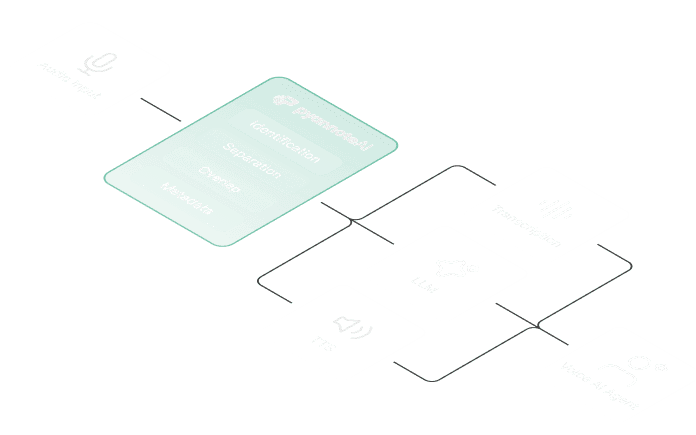
Fast, accurate, and integrated speaker intelligence layer

Fast, accurate, and integrated speaker intelligence layer

100+

100+

languages with consistent transcription

<300 ms

<300 ms

latency for live workflows

Hours of long-form

content processed for major platforms

Stop hand-tagging speakers. Start shipping languages.

Stop hand-tagging speakers. Start shipping languages.

Add the metadata layer that makes automated dubbing, subtitling, and indexing actually work.